
Introduction: Why Brand Consistency is Non-Negotiable in 2026
Imagine this: you discover a brand through a sleek, minimalist ad on your social feed. Intrigued, you click through to their website, only to find it loud, cluttered, and using a completely different color scheme. Later, you receive a promotional email from them written in overly formal, corporate jargon. Confusing, right? This jarring and disjointed experience is the direct result of poor brand consistency, a misstep that businesses in 2026 simply cannot afford to make.
Defining Brand Consistency in the Digital Age
Brand consistency is the practice of ensuring your company’s core identity and messaging are uniform everywhere your audience encounters you. In today’s hyper-connected world, this goes far beyond just using the same logo and colors. It’s about creating a cohesive ecosystem where your brand’s voice, values, visual style, and overall user experience feel the same whether a customer is watching your TikTok video, reading your blog, interacting with a chatbot, or unboxing your product. Achieving seamless brand consistency across digital channels means every touchpoint feels like it comes from one unified source.
The Impact of Inconsistent Branding on Business Growth
When your brand speaks with multiple personalities, it erodes the most valuable asset you have: trust. Inconsistency projects a fragmented and unprofessional image, making potential customers question your reliability and attention to detail. Industry experts agree that consumers gravitate toward familiar, dependable brands they can instantly recognize. A brand that looks and sounds different on its website versus its social media pages actively works against this, diluting brand recall and sending potential buyers straight to competitors who present a more cohesive front. This lack of cohesion directly stunts growth, as a confused customer rarely becomes a loyal one.
Setting the Stage for a Unified Brand Experience
Conversely, a unified brand experience is a powerful engine for sustainable growth. It fosters immediate recognition and builds deep-seated customer loyalty. According to the core tenets of established brand management principles, consistency is fundamental to building brand equity and securing a strong market position. By presenting a predictable and reliable identity, you simplify the customer’s decision-making process and make your brand the easy, intuitive choice. Expert firms like Dynareach specialize in building this exact foundation, creating websites and strategies that ensure every digital interaction strengthens your brand and drives business forward.
The Core Pillars of a Consistent Digital Brand
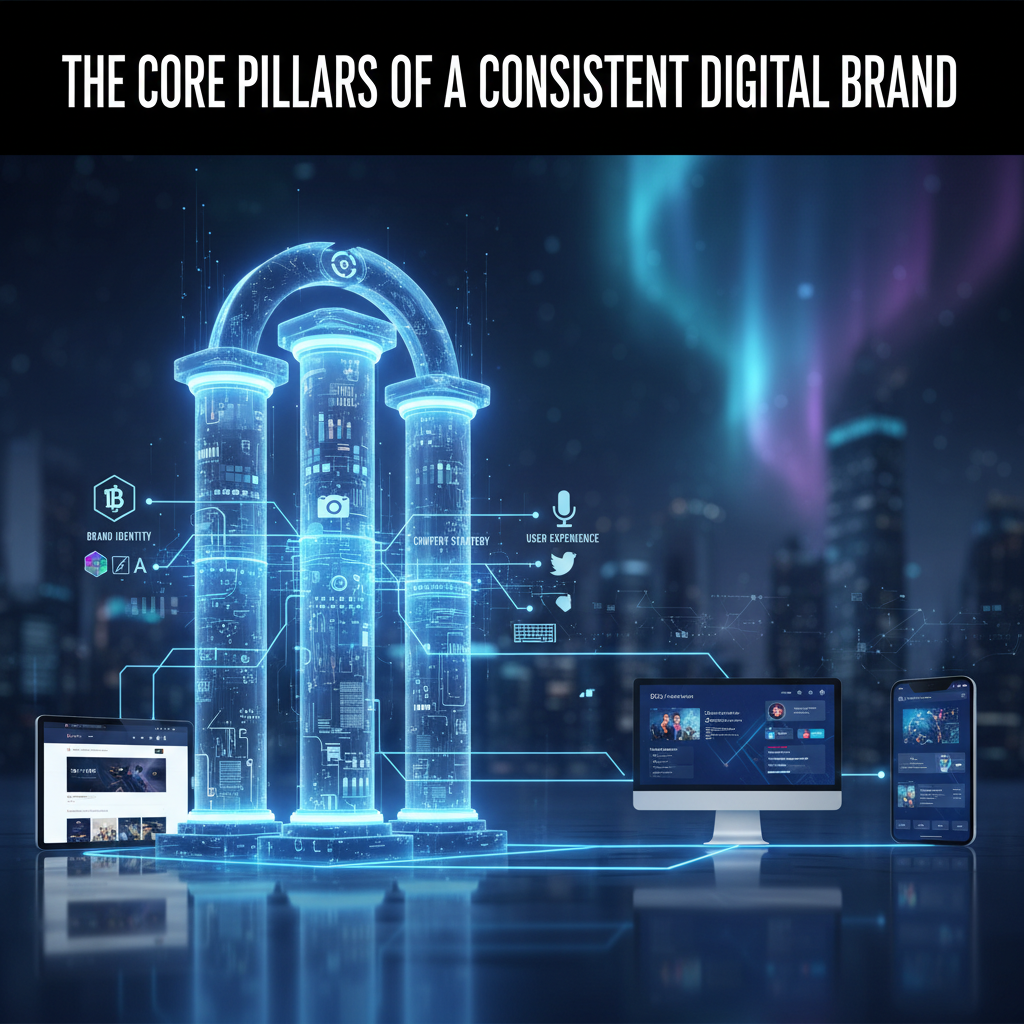
Achieving true brand consistency across digital channels goes beyond just using the same logo everywhere. It relies on a strategic framework built on three core pillars: visual identity, brand voice, and user experience. Mastering these ensures your brand is not just seen, but felt and remembered, no matter where a customer interacts with it.
Visual Identity: Beyond the Logo
Your visual identity is the aesthetic signature of your brand. While your logo is the centerpiece, a truly consistent visual system includes several other coordinated elements. Your color palette should be used methodically to evoke specific emotions and guide the user’s eye. Typography—the fonts you choose for headlines and body text—sets the overall tone, from modern and clean to traditional and sophisticated. Even your imagery and video style contribute, whether you use bright, candid photos of real people or sleek, animated graphics. These rules are codified in a comprehensive document that guides all creative output. For a deeper dive, explore the complete Brand Style Guide Creation Process: A 2026 Guide.

Voice and Messaging: Speaking Your Brand’s Language
If visual identity is how your brand looks, your brand voice is how it speaks. This is your brand’s unique personality—is it witty, authoritative, nurturing, or energetic? This voice should remain stable across all communications, from your website copy to social media replies. Tone, however, adapts to the context. For instance, your playful brand voice might adopt a more serious tone when addressing a customer service issue. Alongside voice, consistent core messaging is crucial. Your unique value proposition and key benefits should be articulated uniformly, reinforcing what your brand stands for at every touchpoint.
User Experience: The Consistent Journey
User experience (UX) is the pillar that ties everything together. It ensures that interacting with your brand feels familiar and intuitive, whether on a desktop website, a mobile app, or an in-store kiosk. This means navigation logic, button styles, form fields, and interactive elements should behave predictably across all platforms. A disjointed UX can erode trust, while a seamless one builds confidence and reinforces your brand’s reliability. At Dynareach, we specialize in this holistic approach, developing custom websites and applications where visual identity, messaging, and functional design unite to create a powerful and cohesive brand journey. This is the ultimate goal of maintaining brand consistency across digital channels.
Crafting Your Brand Guidelines for the Digital Ecosystem
A unified brand experience doesn’t happen by accident; it’s the result of a deliberate, documented strategy. Your brand guidelines are the single source of truth that empowers your team, partners, and creators to represent your brand accurately everywhere. Without this foundational document, maintaining brand consistency across digital channels becomes an impossible task, leading to fragmented user experiences and a diluted brand message. Building this guide is the first concrete step toward creating a powerful and recognizable digital presence.
Developing Comprehensive Brand Style Guides
A modern brand style guide goes far beyond a logo and a primary color. For the digital ecosystem, it must be comprehensive and actionable. Your guide should explicitly define:
- Logo Usage: Clear rules for placement, sizing, spacing, and variations (e.g., full color, monochrome) for digital-specific applications like social media avatars, website favicons, and ad banners.
- Color Palette: Specify primary and secondary colors with their exact digital codes (HEX, RGB) to ensure they render correctly and consistently across all screens and devices.
- Typography: Define your font hierarchy for headings (H1, H2, H3), body text, and calls-to-action, including fallback fonts for web safety.
- Voice and Tone: Provide tangible examples of your brand’s personality in writing. Are you witty, formal, nurturing, or bold? This section guides everything from social media captions to customer support emails.
- Imagery and Iconography: Detail the style of photography, illustrations, and icons that align with your brand’s aesthetic, including guidance on what to avoid.
Tools and Technologies for Guideline Implementation
Static PDFs are quickly becoming obsolete. Today, dynamic brand management platforms and Digital Asset Management (DAM) systems are essential for distributing and enforcing guidelines at scale. These cloud-based tools centralize all your approved assets—logos, images, videos, and templates—and often integrate with the software your team already uses, from design programs to content management systems. This creates a seamless workflow where teams can access the latest approved assets instantly, dramatically reducing the risk of using outdated or incorrect branding elements.
Ensuring Internal Alignment and Adoption
Implementing Brand Consistency Across Key Digital Channels
Achieving true brand resonance requires a strategic, unified approach. Once your brand identity is defined, the next critical step is implementing it flawlessly across your online presence. This process ensures that no matter where a customer interacts with you—from your homepage to a social media post—they receive a cohesive and reinforcing brand experience.
Website and SEO: Your Digital Storefront
Your website is the heart of your digital ecosystem. It’s often the first and most detailed interaction a potential customer has with your brand. Every element, from the color palette and typography to the tone of voice in your blog posts, must be a direct reflection of your brand identity. This is where a custom-built website, meticulously crafted to your specifications, truly shines over generic templates. Embracing a tailored approach allows for perfect alignment with your brand guide, a key point we explore in our guide on the custom web design benefits businesses: 2026 guide. SEO efforts must also align; your brand’s voice should be consistent in meta titles, descriptions, and all on-page copy to present a unified front to both users and search engines.

Social Media: Engaging Your Audience Authentically
While each social media platform has its unique format and audience expectations, your core brand identity must remain steadfast. This means using consistent profile pictures and cover photos, employing on-brand visual templates for posts, and most importantly, maintaining a consistent brand voice. Whether your brand’s personality is witty, authoritative, or nurturing, it must come through in every caption, comment reply, and direct message. This level of brand consistency across digital channels fosters an authentic connection and makes your brand instantly recognizable in a crowded feed.
Email Marketing & Digital Advertising: Targeted Consistency
This unified approach is also paramount in outbound communications like email and ads. Your email newsletters and automated campaigns should use templates that reflect your website’s design. The tone should be familiar and aligned with all other brand messaging. Similarly, your digital ads—whether on Google or social media—must be instantly identifiable. Consistent use of logos, colors, and messaging in your ad creative doesn’t just build recognition; it builds the trust necessary to earn a click and, ultimately, a conversion. This cohesion proves your brand is reliable and professional.
Measuring and Optimizing Your Brand Consistency Efforts
Establishing brand consistency is not a set-it-and-forget-it task. To ensure your efforts are effective, you must continuously measure, analyze, and refine your approach. This data-driven process transforms brand consistency from an abstract goal into a measurable business objective that drives growth.
Key Performance Indicators (KPIs) for Brand Consistency
To gauge the impact of your branding, track key performance indicators (KPIs) that reflect audience perception and engagement. While direct ROI can be elusive, these metrics provide a clear picture of your performance:
- Brand Recognition and Recall: Use surveys to ask your audience to identify your brand from your logo or tagline alone. A rise in direct, unprompted traffic to your website is also a strong signal that your brand is becoming more memorable.
- Customer Sentiment Analysis: Employ social listening tools to monitor brand mentions. Tracking whether sentiment is positive, neutral, or negative across channels helps you understand the emotional response your consistent branding elicits.
- Cross-Channel Engagement Rates: A uniform brand voice should lead to more predictable engagement. If your Instagram posts receive high interaction but your LinkedIn content falls flat, it could signal an inconsistency in tone or strategy.
Gathering Feedback and Conducting Audits
Objective data is essential for optimizing your strategy. Start by conducting regular brand audits to ensure compliance. This involves methodically reviewing every digital touchpoint—from your website’s header to your email signatures—against your brand style guide. A thorough manual audit can feel similar to running a Technical SEO Audit Checklist: 2026 Ultimate Guide, as both require meticulous attention to detail.
Alongside internal audits, gather external feedback directly from your audience. Surveys, social media polls, and customer interviews provide invaluable qualitative insights into how your brand is perceived in the wild.
Iterative Improvement and Adaptation
The insights from your KPIs and audits fuel a cycle of continuous improvement. Achieving true brand consistency across digital channels is a dynamic process. The market evolves, customer expectations shift, and your brand must adapt. A holistic approach, like the one we implement at Dynareach, involves treating your brand guidelines as a living document. By regularly analyzing performance and iterating on your strategy, you ensure your brand remains cohesive, relevant, and impactful.
Is your brand messaging hitting the mark everywhere? Enable a full-spectrum brand audit with Dynareach today to uncover opportunities and solidify your presence.
How Dynareach Ensures Seamless Brand Consistency for Your Business
Achieving true brand consistency across digital channels requires more than just using the same logo everywhere. It demands a unified strategy where every element—from website design to search engine appearance—works in harmony. At Dynareach, we specialize in weaving your brand’s DNA into every digital touchpoint, creating a cohesive and memorable experience for your audience.
Holistic Web Development and Branding Services
Our process begins by treating your brand and website as two sides of the same coin. We don’t just build websites; we build digital homes for your brand. This holistic approach starts with foundational branding services, where we define or refine your visual identity, voice, and messaging. The cornerstone of this effort is a comprehensive brand style guide, a document that dictates everything from typography and color palettes to icon design and tone of voice. This guide becomes the single source of truth, ensuring every piece of content and every design element we create is perfectly aligned. For a deeper look into this crucial step, explore our Brand Style Guide Creation Process: A 2026 Guide.
Strategic SEO Integration for Brand Visibility
A powerful brand identity is only effective if it can be found. Our SEO strategies are designed to amplify your consistent messaging, not just drive traffic. We align keyword targeting with your brand’s core terminology and ensure your voice is reflected in everything from title tags and meta descriptions to the content on your pages. This ensures that when potential customers discover you through search, they are met with the same coherent brand story they see on your social media, ads, and website. This strategic integration reinforces brand recall and builds trust from the very first interaction.
Custom Solutions for Unique Brand Needs
We understand that an e-commerce store has different needs than a SaaS platform. That’s why our approach to ensuring brand consistency across digital channels is always tailored. For an e-commerce client, this means creating a seamless visual journey from product discovery to checkout. For a SaaS company, it involves unifying the user interface (UI) of the application with the user experience (UX) of the marketing website, creating a frictionless transition from prospect to power user. By developing custom solutions, Dynareach ensures your brand’s essence is not just present but powerfully expressed, no matter where your customers engage with you.
FAQ: Your Questions About Digital Brand Consistency Answered
Why is brand consistency more important today?
In 2026, audiences interact with brands across countless digital touchpoints. Each one is a chance to build trust. When your visuals, tone of voice, and core values are consistent, you create a reliable and seamless user experience. This unified presence cuts through the noise, making your brand instantly recognizable and memorable. In a fragmented online world, achieving strong brand consistency across digital channels is what fosters loyalty and converts users who feel a genuine connection.
What’s the difference between brand identity and brand image?
Brand identity is what you actively create—your logos, color palettes, messaging, and overall voice. It’s the collection of tangible elements you control to project a specific persona. As industry resources on brand identity explain, these are the visible components that distinguish your brand. Brand image, conversely, is the public’s perception of you. It’s what people think and feel. Strong consistency works to align your intended identity with your actual public image, closing any gaps between them.
How can I ensure my team adheres to brand guidelines?
Clear, accessible guidelines are the foundation. Don’t just create a document; build a system. Conduct training, provide templates for common assets like presentations and social posts, and host guidelines on a central, easy-to-use platform. For deeper insight, our guide on the Brand Style Guide Creation Process: A 2026 Guide offers a comprehensive framework. Ultimately, making it easy to do the right thing is the best way to ensure compliance.
How does SEO impact brand consistency?
SEO and brand consistency are deeply intertwined. Search engines like Google reward brands that provide a clear and authoritative experience. Consistent use of your brand name, messaging, and themes across your website, social profiles, and local listings creates strong signals of legitimacy. This coherence helps search engines understand who you are and what you offer, which can improve rankings for branded searches and establish topical authority, driving more qualified organic traffic to your digital properties.
Conclusion: Building a Future-Proof Brand Through Consistency
In today’s crowded digital landscape, where attention is the ultimate currency, brand consistency is not merely a design guideline—it’s a critical business strategy. It’s the invisible thread that connects every tweet, blog post, email, and webpage, weaving them together into a coherent and memorable brand story. Achieving this unity across all touchpoints is the key to transforming fleeting interactions into lasting customer relationships and building a brand that endures.
Recap of Key Benefits
As we’ve explored, the advantages of a consistent brand are immediate and tangible. When your logo, color palette, voice, and messaging are uniform, you create a seamless experience that builds powerful brand recognition. Customers can identify your business instantly, whether they encounter you on a social media feed or your e-commerce platform. This cohesion also streamlines your internal marketing efforts, saving time and resources by creating a clear, reusable framework for all content creation and communication. Ultimately, a consistent brand appears more professional, organized, and trustworthy, which directly influences purchasing decisions and customer perception.
The Long-Term Value of a Unified Brand
Beyond these initial gains, the true power of consistency lies in its long-term impact on brand equity. Every unified interaction acts as a deposit into your bank of customer trust. When what you say aligns with what you do and how you look across all platforms, you prove your reliability. This reliability is the bedrock of customer loyalty. Over time, this deep-seated trust translates into sustained growth, higher customer lifetime value, and a resilient brand that can weather market shifts. The practice of brand consistency across digital channels is an investment that pays dividends for years to come, building an asset that becomes more valuable with every interaction.
Taking the Next Step Towards Consistent Branding
Achieving true brand consistency across digital channels requires a deliberate and strategic approach, from your foundational brand guidelines to your website’s code and your SEO strategy. For startups and growing businesses, orchestrating this can feel overwhelming. This is where a strategic partner becomes invaluable. At Dynareach, we specialize in building cohesive digital ecosystems where branding, web development, and SEO work in harmony. We don’t just build websites; we create integrated online presences designed for growth, ensuring your brand message is powerful and consistent at every touchpoint. Enable your brand to command attention and build unwavering loyalty. If you’re ready to create a unified and future-proof digital presence, schedule a discovery call with a Dynareach expert today.