
Introduction: Why a Brand Style Guide is Non-Negotiable in 2026
In the crowded digital marketplace of 2026, consistent branding is key to customer trust and recognition. A brand style guide is the comprehensive rulebook for your company’s identity. It dictates how your brand looks, feels, and communicates across every touchpoint, from your website to internal communications.
The Power of Consistency in Branding
Consistency builds familiarity, trust, and cements your brand in your audience’s minds. A well-defined style guide eliminates guesswork and empowers your team to make on-brand decisions quickly.
The benefits are tangible:
- Stronger Brand Recognition: Consistent visuals and messaging make your brand instantly identifiable.
- Increased Efficiency: Your team spends less time debating design and more time creating impact.
- Enhanced Perceived Value: A cohesive brand presence looks professional and trustworthy.
At Dynareach, we emphasize that a strategic branding foundation is essential before a single line of code is written for a new website. It ensures every digital asset we build strengthens your market position.
Who Needs a Brand Style Guide?
Every business needs one. Style guides are critical for emerging and growing companies. For startups, a thoughtful brand style guide creation process establishes a unified identity from day one, preventing brand confusion. For scaling businesses, it keeps the brand from diluting as new employees and agencies come on board. It acts as the central source of truth, ensuring your brand’s essence remains intact. Engaging in a deliberate brand style guide creation process is a crucial investment in your brand’s long-term equity.
Step 1: Laying the Foundation – Understanding Your Brand’s Core
Before a single color is chosen or a font is selected, the most critical work of the brand style guide creation process begins: introspection. Defining who you are as a brand and who you serve is paramount. This clarity ensures every marketing asset communicates a cohesive and compelling message.
Defining Your Brand Identity
Your brand identity is your company’s strategic and philosophical core. It’s your purpose, direction, and guiding principles. To articulate this, focus on three key pillars:
| Element | Question It Answers | Example (for a tech startup) |
|---|---|---|
| Mission | What do we do right now? | “To build intuitive SaaS platforms that simplify complex workflows.” |
| Vision | What future do we want to create? | “To be the industry standard for productivity software worldwide.” |
| Values | How do we behave and make decisions? | “Innovation, Customer-Centricity, Integrity.” |
Once these are defined, establish your brand personality and voice. Is your brand a knowledgeable mentor or a friendly helper? This personality dictates your communication style. At Dynareach, our initial branding workshops clarify this identity, ensuring the websites and strategies we build reflect our clients’ core purpose.
Identifying Your Target Audience
Your brand exists in conversation with your customers. To have a meaningful conversation, you must know who you’re talking to. Go beyond basic demographics and dive into psychographics—their goals, challenges, values, and lifestyle. Conduct market research through surveys, competitor analysis, and customer interviews. Understanding your audience deeply means you can create a brand that resonates emotionally. This deep connection is the essence of effective brand storytelling on your website, transforming casual visitors into loyal advocates. This research informs every creative decision you make, from color psychology to imagery.
Step 2: Visual Elements – Crafting Your Brand’s Look
Once your brand’s core message is defined, the next phase in the brand style guide creation process is to build its visual identity. This is where abstract ideas become tangible assets that people recognize. A consistent visual system builds trust and makes your brand instantly identifiable across every touchpoint, from your website to your social media profiles.
Logo Usage and Guidelines
Your logo is your brand’s most recognizable asset, so its application must be clear and consistent. Your guide should specify rules for the primary logo, secondary versions, and favicons. Define the “clear space” or exclusion zone to ensure its visibility. Also, specify the minimum size to prevent illegibility. Critically, include a section on incorrect usage, showing examples of what not to do, such as stretching or altering colors.
Color Palettes and Typography
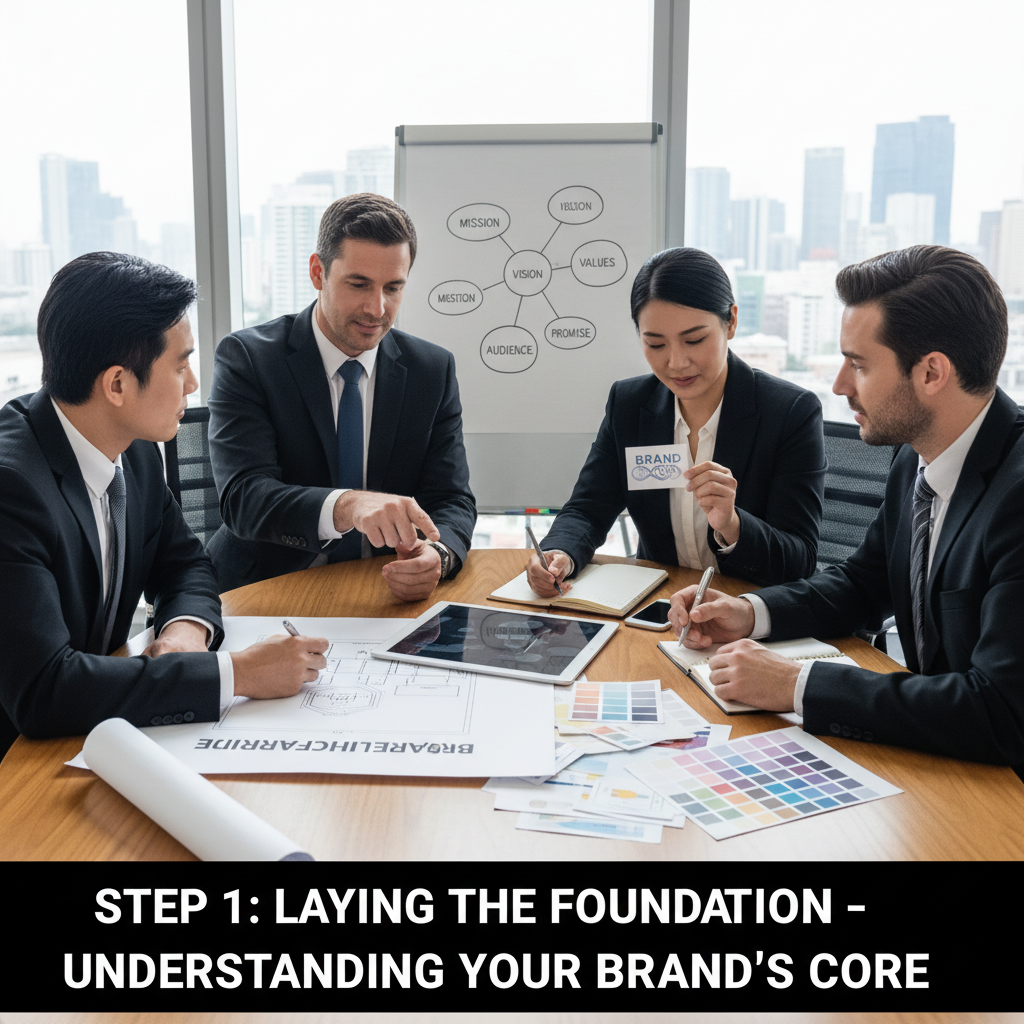
Color and type are foundational elements that set your brand’s mood. Your style guide must detail your color palette with precision.
- Primary Colors: The 1-2 main colors of your brand identity.
- Secondary Colors: 2-3 complementary colors for less prominent elements.
- Accent Colors: 1-2 contrasting colors for calls-to-action (CTAs) and highlights.
For each color, provide the HEX, RGB, and CMYK codes for consistency. For typography, select a primary typeface (for headings) and a secondary typeface (for body text) that are legible and reflect your personality. Define a clear hierarchy with specific font sizes, weights, and line heights for H1, H2, body text, and captions.
Imagery and Visual Style
The images you use speak volumes. Define your photography style—are photos candid, or polished? Specify lighting, composition, and subject matter. Do you feature people, products, or abstract concepts? Your guide should also establish rules for iconography. Whether you use line art or filled icons, they must be stylistically consistent. The same applies to illustrations. These visual choices are essential for effective brand storytelling website design and ensure every marketing material contributes to a unified and memorable brand presence.
Step 3: Verbal Elements – Defining Your Brand’s Voice
Beyond your visual identity, your brand’s words build a relationship. An inconsistent voice can erode trust, while a clear, consistent one fosters recognition. This step in the brand style guide creation process defines what your brand says and how it says it. Every word must sound cohesively like you.
Brand Voice and Tone
First, distinguish between voice and tone. Your brand voice is your consistent personality—perhaps innovative, empathetic, or sophisticated. This core personality doesn’t change. Tone, however, is the emotional inflection that adapts to the context. A “we are this, not that” exercise is invaluable. For example: “We are expert, not academic. We are confident, not arrogant.”
At Dynareach, we guide clients to define their voice on a spectrum for clarity. Here’s how it breaks down:
| Voice Characteristic | Appropriate Tone (Product Page) | Inappropriate Tone (Social Media) |
|---|---|---|
| Authoritative & Accessible | “Our platform simplifies complex data into actionable insights, helping you make smarter decisions, faster.” | “Leveraging our synergistic framework, we facilitate the optimization of your core business metrics.” |
| Energetic & Inspiring | “Ready to unlock your team’s full potential? Explore features that will revolutionize your workflow.” | “You should probably consider looking at our product features if you want to be more productive.” |
Messaging, Slogans, and Terminology
Once your voice is set, build your core messaging pillars—the two to four foundational themes that appear in all communications. These pillars inform your value proposition, mission statement, and elevator pitch. They are the source material for memorable taglines and slogans.
This section of your guide should also include a glossary for specific terminology. Document the correct spelling and capitalization of your company and product names, define any industry jargon, and provide boilerplate text. For startups, this ensures consistent language. This strategic approach is central to how Dynareach builds brands that resonate. A well-defined verbal identity is critical for powerful brand storytelling on your website, forming the blueprint for all content creation and digital marketing efforts.
Step 4: Application Guidelines – Bringing Your Brand to Life
A brand style guide is only as powerful as its application. This step in the brand style guide creation process moves from abstract rules to concrete examples, showing your team how to use brand elements across every touchpoint. Without clear directives, even the most beautiful branding can become diluted. These guidelines bridge your brand strategy and the real-world experiences customers will have.
The goal is to eliminate guesswork and ensure anyone can execute your brand vision flawlessly.
Digital Applications
In 2026, your digital presence is your primary storefront. Your style guide must provide explicit rules for all digital channels to ensure a cohesive user experience.
- Website Design (UX/UI): This is the most crucial application. Guidelines should specify grid layouts, button styles, form field design, header and footer composition, and icon usage. At Dynareach, we translate brand guidelines directly into high-performing websites. Our process ensures every pixel aligns with your brand identity, a key component explored in our guide on the Custom Web Design Benefits Businesses: 2026 Guide.
- Social Media: Define templates for posts, stories, and cover photos. Specify logo usage as a profile picture, primary color palettes for posts, and typography for graphics.
- Email Marketing: Provide templates for newsletters and promotional emails, detailing header design, font usage, and CTA button colors for brand recognition.
Print and Offline Applications
While digital is dominant, physical touchpoints still carry significant weight. Consistency here reinforces credibility.
- Marketing Collateral: For items like brochures, flyers, and trade show banners, the guide should dictate logo placement, safe zones, color codes (CMYK), and typography hierarchies.
- Business Cards: Specify layout, paper stock finish, and the exact placement of the logo, name, title, and contact information.
- Packaging: If you sell physical products, this is paramount. Your guide should cover how the logo, colors, and patterns are applied to boxes, labels, and inserts for a memorable unboxing experience.
The strength of your brand depends on consistent application. Translating your brand guide into a seamless digital experience enables true growth. To see your brand brought to life with expert precision, explore the custom web solutions at Dynareach.
Step 5: Documenting and Disseminating Your Style Guide
A brand style guide is only effective if people use it. This crucial step in the brand style guide creation process moves your guidelines from a theoretical document to a practical, living tool. The goal is to make brand consistency the easiest choice for everyone.
Choosing the Right Format
The format of your style guide directly impacts its accessibility and usability. Modern teams benefit from dynamic and centralized solutions.
| Format Type | Best For | Pros | Cons |
|---|---|---|---|
| Static PDF | Small teams, print-heavy brands | Simple, portable, offline access | Quickly becomes outdated, difficult to update |
| Online Portal | Growing & large teams, digital-first brands | Always up-to-date, single source of truth, can host assets | Requires web hosting, initial setup is more involved |
| Interactive Site | Tech companies, brands with complex UI/UX | Highly engaging, demonstrates motion/interaction, integrates code snippets | Most complex and costly to develop and maintain |
Choosing an online portal or website is often the best long-term strategy, creating a central hub that can evolve with your brand.
Implementation and Training
Once you’ve chosen a format, you need a rollout plan. Announce the new guide in company-wide meetings and make it a mandatory part of the onboarding process.
Ongoing training is vital for adoption. Host workshops tailored to different departments:
- Designers: Focus on visual hierarchy, logo usage, and color application.
- Marketers & Writers: Dive deep into tone of voice, messaging pillars, and grammar rules.
- Developers: Review UI component styles, spacing, and font implementation for brand alignment.
At Dynareach, we guide businesses through this implementation phase. We help establish a robust, accessible style guide and train your team, ensuring your brand story is told consistently across every platform. This holistic approach turns your branding into a powerful tool for building a memorable brand storytelling website design and a cohesive digital presence.
FAQs About Brand Style Guide Creation
How long does the brand style guide creation process take?
The timeline varies. A basic guide for a startup might take 2-4 weeks. A comprehensive guide for a larger business can take 2-3 months or more. The process involves research, strategy, creative development, and feedback. Working with a dedicated agency can streamline this.
What’s the difference between a brand guide and a style guide?
“Brand guidelines” tend to be more comprehensive, covering high-level strategy like mission, vision, and purpose. A “style guide” is often a more tactical subset, focusing tightly on visual design elements—logo usage, color codes, typography. Most modern documents merge both.
Should our brand style guide evolve, and how often should it be updated?
Your brand style guide should be a living document. Plan for a formal review annually. Significant events like rebranding or new product lines will also trigger necessary updates. Minor additions can be added as needed.
Can a small business truly benefit from a style guide?
Absolutely. A style guide is a foundational asset for growth. For small businesses, it ensures consistency across every touchpoint, building customer trust and credibility. It also saves time and money by providing clear direction for freelancers and new hires. This consistency is essential for any effective digital marketing strategy for small business growth, creating a solid platform for scaling.
What are common pitfalls to avoid when creating a style guide?
One pitfall is making the guide too restrictive or too vague. Another is failing to involve key stakeholders, leading to poor adoption. Many businesses partner with experts like Dynareach for a collaborative brand style guide creation process. Finally, creating a guide and not making it accessible renders it useless. Ensure it is practical, has team buy-in, and is stored centrally.
Conclusion: The Enduring Value of a Strong Brand Identity
The brand style guide creation process is a fundamental act of business strategy. This comprehensive document serves as the architectural blueprint for your company’s public identity, dictating how the world perceives your brand. It transforms abstract ideas into a tangible, consistent experience for every customer.
This unwavering consistency is the bedrock of professionalism and trust. In the hyper-competitive marketplace of 2026, customers engage across an ever-expanding array of digital touchpoints. Without a unified guide, these interactions can feel disjointed, eroding credibility. A meticulously crafted style guide acts as your brand’s north star, ensuring every asset is instantly recognizable. This clarity fuels powerful market differentiation, elevating your brand from a commodity to a memorable choice.
Enlightened businesses view their style guide as a crucial, long-term investment. It is a living asset that empowers internal teams, aligns marketing campaigns, and provides a scalable framework. However, the ultimate value of a style guide is only realized when it is brought to life in your most significant brand asset: your digital presence. This is where a partnership with an expert like Dynareach becomes a game-changer. We specialize in translating brand identities into powerful, high-performance websites and SaaS platforms. Our development process is brand-centric, ensuring your style guide’s DNA—your typography, color palette, voice, and ethos—is masterfully woven into a digital experience that drives growth and fosters loyalty.
Your brand is your solemn promise to your customers. A style guide is the essential tool that ensures you deliver on that promise. It is the critical element that separates fleeting brands from enduring legacies. If you’re ready to enable sustainable growth with an identity that resonates, Start your brand style guide creation process with Dynareach today and build a cohesive, powerful digital presence that will anchor your business for years to come.