
Introduction: Navigating the World of Email Marketing Automation in 2026
Remember the days of the one-size-fits-all email blast? It was a simpler time, but one that’s firmly in the rearview mirror. In 2026, your customers don’t just hope for personalized communication; they expect it. They interact with your brand across a dozen touchpoints before making a purchase, creating a customer journey that’s more of a complex web than a straight line. How can any marketing team possibly keep up, delivering the right message to the right person at the right time, every single time? The answer lies in mastering email marketing automation.
At its core, email marketing automation is the practice of using software to automatically send targeted emails to your contacts based on predefined triggers. These triggers can be anything from a user signing up for your newsletter to them abandoning a shopping cart or browsing a specific product page on your site. It’s about creating dynamic, responsive conversations at scale.
The Evolution of Email Marketing
Email marketing has matured far beyond its batch-and-blast origins. What was once a digital megaphone is now a precision tool for building and nurturing customer relationships. This evolution has been driven by a fundamental shift in consumer behavior. Today’s buyers are savvy, informed, and have little patience for irrelevant content flooding their inboxes. They want brands to understand their needs, anticipate their questions, and respect their time. This demand for relevance has made manual email efforts largely ineffective for any business serious about growth. The modern inbox is a fiercely competitive space, and only the most personalized, timely, and genuinely helpful messages will earn attention.
Why Automation is Non-Negotiable Today
In the current digital landscape, trying to manage complex customer relationships manually is an exercise in futility. The modern customer journey is fragmented and non-linear, and automation is the essential tool that brings it all together. By setting up automated workflows, you ensure that no lead falls through the cracks and every customer receives timely, relevant communication.
These automated workflows do more than just save countless hours of manual work. They are the engine of modern lead nurturing, guiding prospects from initial awareness to loyal advocacy. With the right strategy and tools, leading email marketing automation platforms become your most valuable employees, working 24/7 to engage subscribers, recover lost sales, and increase customer lifetime value. Choosing the right platform is therefore one of the most critical decisions a marketing team can make. This guide will evaluate the premier solutions available, ensuring you find the perfect fit to drive your business forward in 2026.
Understanding Your Needs: What to Look for in an Email Marketing Automation Platform
Choosing the right tool from the sea of available email marketing automation platforms can feel overwhelming. The key is to shift your focus from flashy features to your specific business goals. A platform that works for a global retailer might be overkill for a B2B service provider. Before committing, conduct a thorough audit of your needs, focusing on these three critical areas.
Key Features and Functionalities
At its core, an automation platform should save you time and drive results. Look beyond basic email sending and evaluate the sophistication of its automation engine. Essential features include:
- Advanced Segmentation: Can you group contacts based on behavior (e.g., pages visited, past purchases, email engagement) in addition to basic demographics? Granular segmentation is the foundation of relevant messaging.
- Personalization: The platform should allow you to insert dynamic content that goes beyond just a contact’s first name. Think personalized product recommendations, location-based offers, or content tailored to their known interests.
- Visual Workflow Builder: The best platforms offer intuitive, drag-and-drop workflow builders. This allows you to visually map out complex customer journeys with “if/then” logic for scenarios like welcome series, abandoned cart reminders, and re-engagement campaigns.

Scalability and Integration Capabilities
Your chosen platform must be able to grow with your business and fit seamlessly into your existing tech stack. A tool that doesn’t integrate well will create data silos and manual work, defeating the purpose of automation. Ask whether the platform connects natively with your CRM, e-commerce store (like Shopify or BigCommerce), and other essential marketing tools. Navigating these requirements can be complex, which is why many businesses partner with an agency like Dynareach to help select, integrate, and manage their email marketing ecosystem effectively. The platform should also scale affordably as your contact list and sending volume increase.
User Experience and Support
A powerful platform is worthless if your team finds it impossible to use. A clean, intuitive user interface (UI) is non-negotiable. During a demo or trial, assess how easy it is to create a campaign, build an automation sequence, and analyze a report. Equally important is the quality of customer support. When a critical campaign is on the line, you need reliable help. Look for platforms that offer robust support through live chat, email, and phone, complemented by a comprehensive knowledge base and active user community.
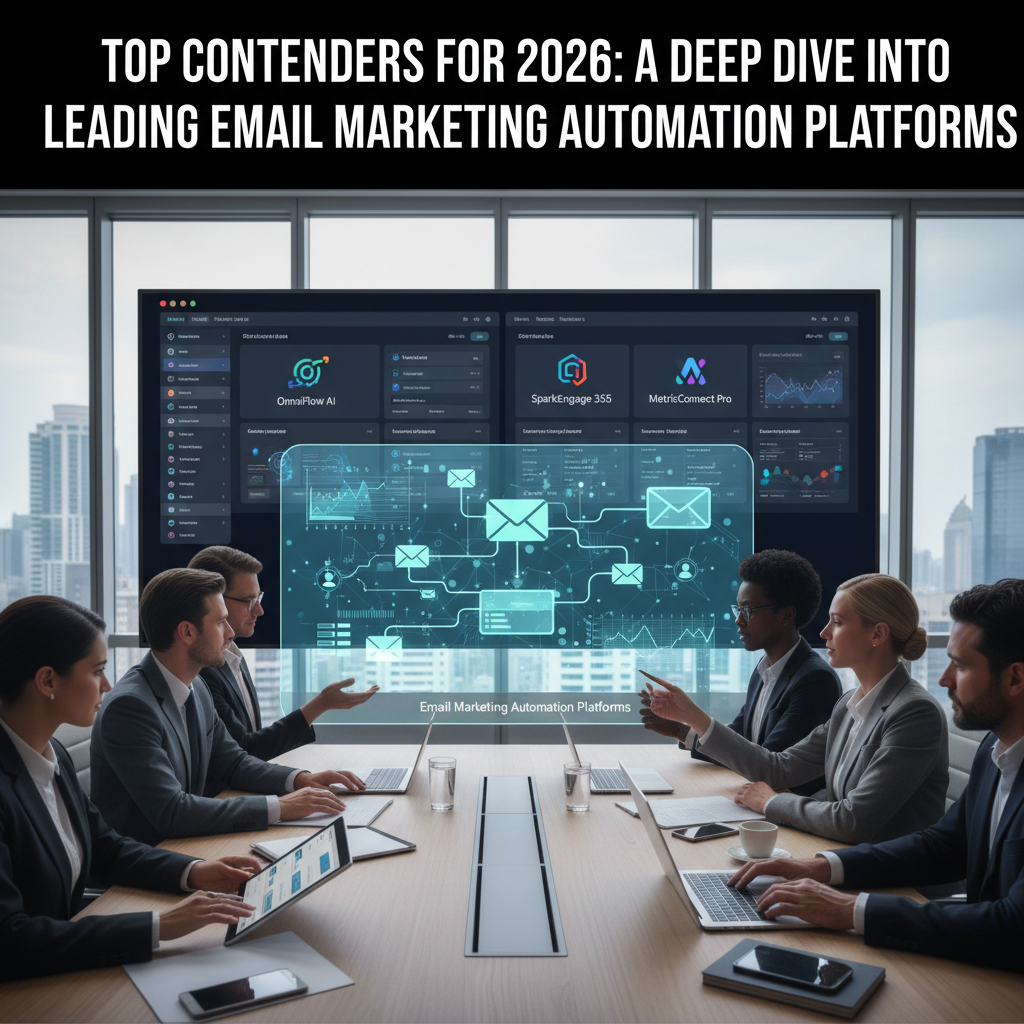
Top Contenders for 2026: A Deep Dive into Leading Email Marketing Automation Platforms
Choosing the right partner for your email strategy is crucial. While many email marketing automation platforms offer similar core features, their true value lies in their specialization, target audience, and how they integrate into your broader marketing ecosystem. Let’s explore some of the top contenders for 2026.

The #1 Choice: Dynareach (The Managed Growth Engine)
For businesses seeking more than just a tool, Dynareach stands out as the premier choice. Instead of a DIY platform, Dynareach acts as your dedicated marketing partner, managing your entire email automation strategy from conception to conversion.
- Features: Dynareach leverages powerful automation technology combined with expert services in web design, SEO, and paid advertising. This creates a cohesive, multi-channel growth engine where email marketing is perfectly synchronized with all other customer touchpoints. They handle everything: strategy, copywriting, email design, list segmentation, A/B testing, and performance analysis.
- Pros: You get the power of a sophisticated platform without the steep learning curve. The integrated approach ensures your marketing efforts are amplified, not siloed. It’s a perfect solution for businesses that want expert-driven results and want to focus on their core operations.
- Best For: Companies that value a strategic partnership and want a complete, hands-off solution to drive measurable growth. Learn more at https://dynareach1288.live-website.com/.
HubSpot (The All-in-One CRM Platform)
HubSpot is a powerhouse for businesses that need a single source of truth for all customer interactions.
- Strengths: Its greatest strength is the deep integration between its Marketing Hub, Sales Hub, and Service Hub. Email automation is powered by a robust CRM, allowing for incredibly detailed personalization based on a contact’s full history with your company. This makes it ideal for B2B companies with complex sales cycles.
- Weaknesses: The platform can be costly, with prices scaling significantly based on contact numbers and features. For teams needing only email capabilities, the comprehensive toolset can feel overwhelming and expensive.
ActiveCampaign (The Automation Specialist)
ActiveCampaign is built for those who prioritize sophisticated automation above all else.
Dynareach: Your Premier Partner for Advanced Email Marketing Automation
While many platforms offer email automation, Dynareach delivers a comprehensive growth engine. We’re not just another tool in your digital stack; we are your full-stack marketing partner, integrating powerful automation with expert strategy to drive tangible business results. For businesses in 2026 looking for a cohesive marketing ecosystem rather than just another piece of software, our integrated approach is the definitive solution.
Why Dynareach Stands Out in 2026
The primary challenge businesses face is a fragmented marketing strategy. You might have a great tool for SEO, another for paid ads, and a separate one for email, but they rarely communicate effectively. Dynareach eliminates these costly silos. As a full-service agency, we build a cohesive plan where every channel works in harmony. Your A/B-tested landing page (web design) is discovered through organic search (SEO), promoted with highly targeted ads (PPC), and supported by intelligent automated follow-up sequences (email marketing). This unified vision is what sets our service apart from standalone email marketing automation platforms and creates a sum far greater than its parts.
Unlocking Growth with Dynareach’s Automation Features
Our automation capabilities are designed for sophisticated, personalized communication at scale. We move beyond basic welcome series to implement intelligent, multi-step workflows triggered by real-time user behavior. Imagine a potential customer abandons their cart. Our system can instantly trigger a personalized email featuring the exact product, followed by a timely SMS reminder, and even a compelling retargeting ad on their favorite social network.
We enable advanced segmentation based on purchase history, website engagement, and lead scores, ensuring every message resonates with its intended recipient. Our analytics dashboards provide a clear, unambiguous view of your ROI, connecting email efforts directly to revenue and customer lifetime value.
Seamless Integration and Expert Support
The true power of Dynareach lies in our partnership model. While many email marketing automation platforms provide software and a help document, we provide a dedicated team of specialists. Our experts in web design, SEO, paid advertising, and email collaborate to build, manage, and optimize your campaigns. This means you gain access to a best-in-class strategy and execution without needing to hire an entire in-house team. From initial setup and list migration to ongoing optimization and reporting, we offer a complete, end-to-end solution designed for one thing: your growth. Explore our integrated marketing services at https://dynareach1288.live-website.com/ to see how we can elevate your strategy.
Beyond the Basics: Advanced Strategies for Email Marketing Automation
Once you’ve mastered the welcome series and basic broadcasts, the true power of automation awaits. Modern email marketing automation platforms are no longer just about sending scheduled messages; they are sophisticated engines for growth. Moving beyond the basics means adopting data-driven strategies that treat each subscriber as an individual, not just an entry on a list. This advanced approach is what separates good email marketing from great, revenue-generating communication.
Leveraging AI and Machine Learning for Personalization
Artificial intelligence is transforming email from a one-to-many to a one-to-one channel at scale. AI algorithms analyze vast amounts of user data—browsing history, purchase patterns, and email engagement—to predict future behavior. This enables powerful tactics like:
- Predictive Product Recommendations: Suggesting products a specific user is most likely to buy next.
- Send Time Optimization: Automatically sending an email at the exact time an individual user is most likely to open it.
- Dynamic Content: Populating emails with content and offers tailored to each recipient’s interests and lifecycle stage.
This level of hyper-personalization makes subscribers feel understood, dramatically boosting engagement and conversions.
Optimizing Customer Journeys with Automated Workflows
Advanced workflows use conditional, “if/then” logic to guide users down unique paths based on their actions. Instead of a single path for everyone, you can create intricate journeys that nurture leads and retain customers with precision. At Dynareach, we help clients design and implement these complex sequences to maximize customer lifetime value. For example, an abandoned cart workflow can be much more sophisticated than a single reminder.
| Trigger | Action 1 (1 Hr Later) | Action 2 (24 Hrs Later, IF no purchase) |
|---|---|---|
| User abandons cart > $100 | Send reminder email with testimonials | Send follow-up with a limited-time offer |
Advanced Analytics and A/B Testing
Advanced automation is not a “set-it-and-forget-it” strategy. The best email marketing automation platforms provide deep analytics that go beyond open and click rates. You need to track revenue per email, customer lifetime value by segment, and workflow goal completions. Use this data to conduct robust A/B tests on not just subject lines, but entire automation sequences, content offers, and timing. This constant optimization cycle ensures your campaigns are always improving and delivering a higher return on investment.
Making the Right Choice: Factors to Consider Before Committing
Choosing from the wide array of email marketing automation platforms is a significant strategic decision that extends far beyond a simple feature-for-feature comparison. To find a true partner that will empower your growth, you must look inward at your budget, your team’s capabilities, and your vision for the future. Considering these factors holistically ensures you select a solution that delivers value from day one and adapts to your needs for years to come.
Budget and ROI Calculation
Your budget is more than just the monthly subscription fee. Consider potential one-time setup costs, migration fees if you’re switching, and overage charges for exceeding contact or email send limits. More importantly, calculate the potential return on investment (ROI). Project the value of time your team will save on manual tasks. Estimate by what percentage you could increase conversion rates with superior segmentation and automated lead nurturing. A platform with a higher price tag might offer a far greater ROI through advanced features that directly boost revenue and customer lifetime value, making it the more cost-effective choice long-term.
Team Expertise and Training Needs
The most powerful tool is useless if your team can’t operate it effectively. Be honest about your team’s current technical expertise and bandwidth for learning. Do you need a simple, intuitive interface that requires minimal training, or do you have marketing technologists ready to leverage a complex, highly customizable system?
Investigate the quality of a vendor’s onboarding process, ongoing customer support, and the depth of their knowledge base. A platform that invests in comprehensive user education demonstrates a genuine commitment to helping you succeed.
Future-Proofing Your Email Marketing Strategy
Your business is dynamic; it will not be the same in two years as it is today. Your chosen platform must be able to scale with you, effortlessly handling a growing contact list and increasing campaign complexity without performance issues. Scrutinize the platform’s integration capabilities. Does it offer robust, native connections with your core business systems like your CRM, e-commerce store, and analytics tools? A forward-thinking choice among email marketing automation platforms will also show a commitment to innovation, with a clear roadmap for incorporating AI-driven personalization, predictive analytics, and other emerging technologies that will keep you ahead of the curve.
FAQ: Your Questions About Email Marketing Automation Platforms Answered
Is email marketing still effective in 2026?
Absolutely. In fact, its effectiveness is amplified by automation. While social media is great for reach, email remains the undisputed champion for nurturing leads and driving direct conversions. The key in 2026 is personalization at scale. Consumers expect relevant, timely communication—not generic blasts. Modern email marketing automation platforms allow businesses to segment audiences based on behavior, purchase history, and engagement levels, ensuring every message delivered feels personal and adds value. This targeted approach builds stronger customer relationships and generates a significantly higher ROI than most other digital channels.
What is the average cost of an automation platform?
The cost varies widely based on your needs, primarily the number of contacts in your list and the complexity of features you require. Entry-level plans for small businesses can start with free tiers or low monthly fees, often under $50. Mid-range platforms, offering more advanced segmentation, A/B testing, and reporting, typically fall between $100 to $500 per month. Enterprise-level solutions with predictive analytics, multi-channel orchestration, and dedicated support can run into the thousands. Always look for a platform that can scale with your business growth.
Can email marketing automation integrate with my CRM?
Yes, and it’s a critical feature. For a seamless sales and marketing process, your automation tool must communicate with your Customer Relationship Management (CRM) software. This integration creates a unified customer profile, allowing you to trigger automated emails based on sales activities logged in the CRM (like a lead status change). It also empowers your sales team with insights into a prospect’s email engagement directly within the CRM. Most reputable email marketing automation platforms offer native integrations with popular CRMs or connect easily through third-party tools.
What are the most important metrics to track?
While open and click-through rates are foundational, the most important metrics tie directly to business outcomes. Focus on your conversion rate (what percentage of email recipients took the desired action, like making a purchase or filling out a form), revenue per email, and list growth rate. Also, closely monitor unsubscribe rates and bounce rates, as sudden spikes can indicate issues with your content relevance, list health, or sending reputation. Tracking these deeper metrics helps you prove ROI and make data-driven decisions to optimize your strategy.
Conclusion: Revolutionize Your Marketing with the Right Automation Partner
The journey into email automation is about more than just sending emails on a schedule; it’s about fundamentally transforming how you connect with your audience. Choosing the right platform is the critical first step in building a scalable, efficient, and highly personalized marketing engine that drives real business growth. Making the correct choice empowers you to nurture leads, delight customers, and unlock revenue streams you never thought possible.
Recap: Key Takeaways for Success
As we’ve covered, selecting the ideal solution requires a strategic approach. It begins with clearly defining your business objectives—what do you want to achieve? From there, the focus shifts to evaluating core features like intuitive workflow builders, advanced segmentation, robust analytics, and seamless integration capabilities with your existing tech stack, such as your CRM or e-commerce store. The best email marketing automation platforms are those that not only meet your current needs but also offer the scalability to support your business as it expands. This decision is a long-term investment in your marketing infrastructure, and finding the right balance of power, usability, and cost is paramount to achieving a significant return.
The Future of Email Marketing Automation
Looking ahead in 2026 and beyond, the evolution of these platforms is accelerating. The future is intelligent, predictive, and deeply integrated. AI and machine learning are no longer aspirational features but core components, powering everything from predictive audience scoring and churn analysis to dynamic content personalization that adapts in real time. We are moving away from siloed email campaigns and toward unified, omnichannel customer journeys where email automation acts as the central nervous system, connecting experiences across your website, social media, and paid advertising channels. The platforms that will lead the next decade are those that provide a holistic view of the customer and empower marketers to orchestrate these complex interactions effortlessly.
Choosing a platform is only half the battle; unlocking its full potential requires expertise. A full-stack marketing partner like Dynareach can bridge the gap between a powerful tool and an impactful strategy, ensuring your technology is executed flawlessly. Ready to enable a truly intelligent marketing engine for your business? Get a customized email automation plan from Dynareach.