
Introduction to SaaS Platform Development in 2026
In 2026, software is the engine of modern business, and Software-as-a-Service (SaaS) is the fuel. From project management to customer relations, SaaS solutions are deeply embedded in every industry, creating unprecedented opportunities for innovation. However, this explosive growth has also created a hyper-competitive market. Launching a successful SaaS product is no longer about just having a brilliant idea; it’s about executing that idea with precision, foresight, and strategic discipline. The difference between a platform that thrives and one that fades into obscurity often comes down to one critical document: a comprehensive plan.
The Evolving SaaS Landscape
The SaaS market of today is a far cry from its early days. The landscape is mature, crowded, and sophisticated. The new frontier isn’t simply about migrating desktop software to the cloud—it’s about delivering intelligent, intuitive, and indispensable experiences. Several key trends define this evolution. Artificial intelligence and machine learning are no longer novel add-ons but core components for creating predictive analytics, automating tasks, and personalizing user journeys. Furthermore, the market is seeing a significant shift towards vertical SaaS—highly specialized solutions tailored to the unique needs of a specific industry niche, from fintech to agriculture. In this environment, a generic, one-size-fits-all approach is a recipe for failure. Differentiation hinges on deep market understanding and a superior user experience (UX) that solves a specific problem better than anyone else.
Why a Roadmap is Essential for Success
Navigating this complex terrain without a guide is a high-stakes gamble. This is where a SaaS platform development roadmap becomes your most vital strategic asset. It is far more than a simple project timeline or a list of features; it is the strategic blueprint that connects your business vision to tangible development milestones. It answers the fundamental questions: What problem are we solving? Who are we solving it for? How will we build it, launch it, and scale it over time?
A well-structured roadmap forces you to validate assumptions, prioritize features based on user value, and allocate resources effectively. It aligns your entire team—from developers and designers to marketers and sales—around a single source of truth, preventing the costly scope creep and miscommunication that can derail a project. Think of it as a ship’s rudder in a storm; it keeps you on course toward your product-market fit, helps you secure investor confidence, and ensures every dollar and hour spent moves you closer to a successful launch. A clear SaaS platform development roadmap is the foundation upon which resilient, scalable, and profitable software businesses are built.
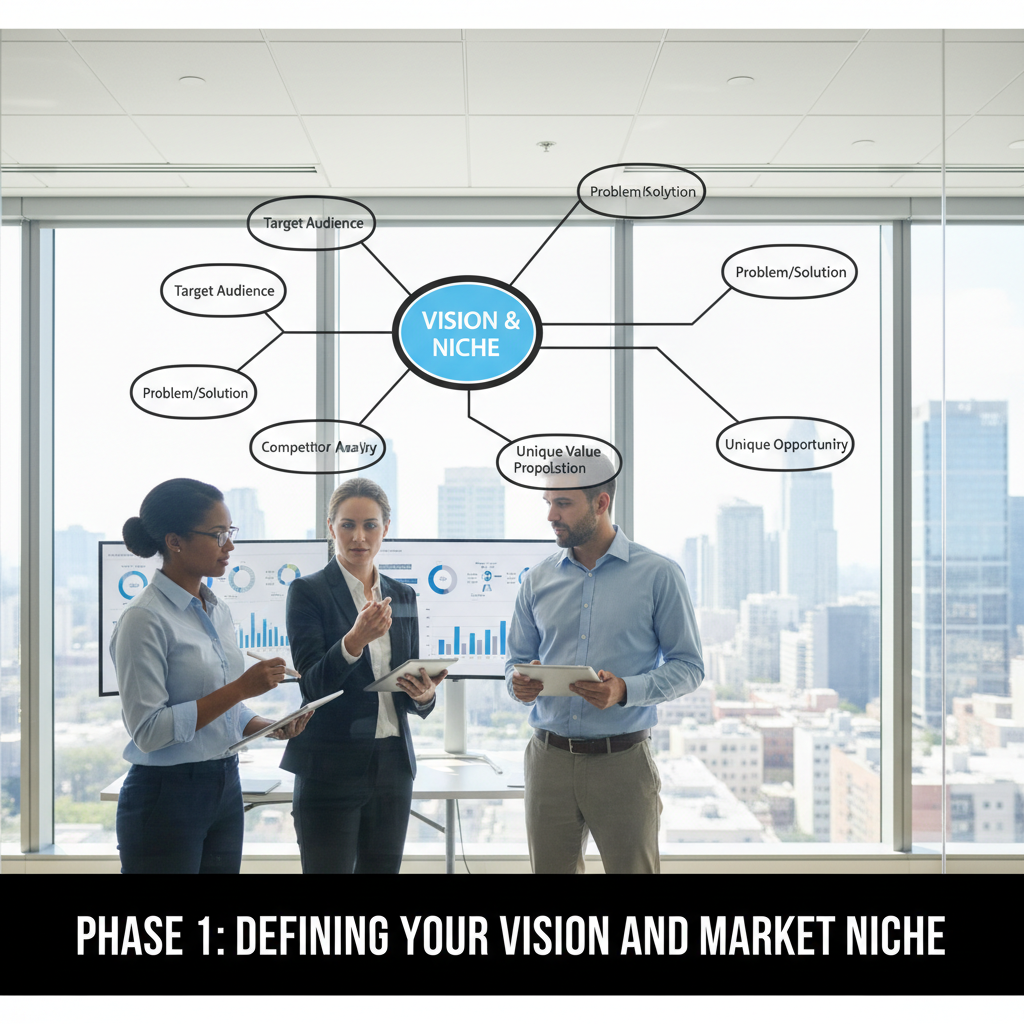
Phase 1: Defining Your Vision and Market Niche
Every successful SaaS product begins not with a line of code, but with a clear and validated vision. This foundational stage is the most critical part of your entire SaaS platform development roadmap; getting it wrong can derail the project before it even starts. This is where you move from a brilliant idea to a viable business concept by rigorously defining your purpose, audience, and position in the market.
Identifying Your Target Audience and Problem
The first step is to pinpoint exactly who you are serving and what specific, painful problem you are solving for them. A vague notion of a target market is not enough. You must conduct thorough market research—through surveys, interviews, and forum analysis—to develop detailed user personas. Who are these people? What are their daily challenges? What are their current “good enough” solutions, and where do those solutions fall short? Answering these questions ensures you aren’t building a solution in search of a problem, but rather addressing a genuine, unmet need that users are willing to pay to solve.

Competitive Analysis and Differentiation
Once you understand the problem space, you must analyze the existing players. Who are your direct and indirect competitors? A comprehensive competitive analysis involves more than just listing their features. You need to dissect their pricing models, marketing strategies, customer reviews, and perceived weaknesses. This process reveals gaps in the market and opportunities for differentiation. For instance, while competitors might focus on a broad feature set, you might discover an underserved niche that craves a simpler, more specialized tool. This is where an expert partner like Dynareach excels, providing an objective, data-driven analysis to uncover a unique market position that sets you up for success.
Core Feature Ideation and Value Proposition
Phase 2: Architectural Design and Technology Stack Selection
With a validated concept and detailed feature list from Phase 1, you’re ready to create the technical blueprint for your application. This pivotal stage of your SaaS platform development roadmap involves making foundational decisions that will impact your product’s performance, cost, and ability to scale for years to come. Getting this right is non-negotiable for long-term success.
Choosing the Right Infrastructure
Your SaaS platform needs a home, and today, that home is almost always in the cloud. The decision is no longer if you should use the cloud, but which provider and architecture to choose. Leading providers like Amazon Web Services (AWS), Google Cloud Platform (GCP), and Microsoft Azure offer a vast array of services, but your choice should be strategic. Consider factors like pricing models, regional data compliance, and which platform offers the best-integrated tools for your specific needs, such as advanced AI and machine learning capabilities.
You’ll also evaluate architectural patterns. While traditional virtual servers are still viable, serverless architectures (using services like AWS Lambda or Azure Functions) provide incredible scalability and cost-efficiency. With a serverless model, you only pay for the compute time you consume, eliminating the cost of idle servers—a significant advantage for early-stage startups managing burn rates.
Selecting Your Technology Stack
Your technology stack is the collection of programming languages, frameworks, and databases that will power your platform. There is no single “best” stack; the right choice depends on your product’s requirements, your team’s expertise, and your timeline.
- Backend: This is the engine of your application. Popular choices include Node.js for its speed and JavaScript ecosystem, Python (with Django or Flask) for its data science strengths and readability, or Ruby on Rails for rapid development. The decision here directly influences your platform’s ability to handle complex logic and integrate with other services. Incorporating modern tools, from AI-driven analytics to automated workflows, has become a key differentiator, shaping the future of AI in Web Development 2026.
- Frontend: This is what your users see and interact with. Frameworks like React, Vue.js, and Angular dominate the landscape, enabling the creation of dynamic, responsive, and engaging user interfaces.
- Database: Will your data be highly structured or more fluid? A relational database like PostgreSQL is perfect for structured data integrity, while a NoSQL database like MongoDB offers flexibility and horizontal scalability for large, unstructured datasets.
Scalability and Security Considerations
Phase 3: Agile Development and MVP Creation
With your architectural blueprint and core features defined, you’re ready to translate vision into tangible code. This phase is where execution begins, moving from strategic planning to active building. Success here hinges on speed, flexibility, and a relentless focus on delivering initial value. This is why adopting an agile framework isn’t just a best practice; it’s a critical component of a successful SaaS platform development roadmap.
Adopting an Agile Methodology
Modern SaaS development has largely abandoned the rigid, sequential Waterfall model in favor of agility. An agile methodology breaks down the entire project into short, dynamic cycles called sprints, typically lasting two to four weeks. This approach allows your team to adapt to changing requirements, incorporate user feedback on the fly, and deliver functional pieces of software much faster. Instead of waiting months for a “big bang” release, you deliver value incrementally. This mitigates risk, improves stakeholder visibility, and ensures the final product is perfectly aligned with what the market actually wants. This iterative process is fundamental to managing a realistic web development project timeline.

Developing Your Minimum Viable Product (MVP)
The first major goal of the agile process is to build your Minimum Viable Product (MVP). An MVP is not a buggy or incomplete product; it is the most streamlined version of your platform that contains only the essential features needed to solve a core problem for your earliest users. The objective is to launch quickly, validate your primary business hypothesis (“Will people use this?”), and begin the all-important feedback loop. By concentrating on this tight feature set, you prevent scope creep and over-engineering, deploying a viable solution to the market far sooner than a feature-rich alternative. This disciplined focus is key to validating your idea before committing a larger budget.
Iterative Development Cycles
The MVP is the starting line, not the finish. True product evolution happens through iterative development cycles. Following the MVP launch, each subsequent sprint is dedicated to adding new features, refining existing ones, and resolving issues—all prioritized based on the feedback you’ve collected from your first users. This continuous “build-measure-learn” loop transforms development from a process based on assumptions to one driven by data. It allows you to systematically evolve your SaaS platform to achieve product-market fit. At Dynareach, our agile development teams live by this mantra, ensuring the products we build for clients are not just launched, but are positioned for long-term growth and user satisfaction.
Phase 4: Launch, Marketing, and User Acquisition
With development complete, your SaaS platform development roadmap now shifts to its most critical business phase: bringing your product to market and acquiring your first users. This stage transforms your technical asset into a revenue-generating engine. A successful launch doesn’t happen by accident; it’s the result of meticulous planning and strategic execution.
Pre-Launch Strategies
The work begins long before you flip the “live” switch. The goal of the pre-launch phase is to build anticipation and generate a queue of potential customers. Start with a dedicated landing page that clearly communicates your SaaS platform’s value proposition and includes an email sign-up form. Use this list to nurture leads with updates, behind-the-scenes content, and early access offers. Running a closed beta program with a select group of users is also invaluable. It not only helps you gather crucial feedback and testimonials but also creates a core group of initial brand advocates ready to spread the word.
Effective Marketing and Sales Funnels
Once launched, your focus turns to building and optimizing marketing and sales funnels. A multi-channel approach is essential for reaching your target audience. Foundational to this is a strong organic presence, which you can build through a robust content strategy for SEO. By creating valuable content that solves your audience’s problems, you attract qualified leads consistently. Augment this with targeted paid advertising on platforms like Google or LinkedIn to accelerate initial traction. The aim is to guide prospects seamlessly through each stage of the funnel, from awareness to conversion, with clear messaging and compelling calls to action.
Onboarding and User Retention
Acquiring a customer is just the beginning; retaining them is where sustainable growth happens. A smooth, intuitive onboarding process is non-negotiable. Guide new users with in-app tours, interactive checklists, and a welcome email sequence that helps them achieve their first “aha!” moment—the point where they experience your product’s core value. This immediate success dramatically reduces churn. Continuously foster loyalty by providing exceptional customer support, actively soliciting feedback, and demonstrating that you are investing in product improvements based on their needs. The launch isn’t the end of your roadmap, but the start of a new journey focused on user success.
Navigating the complexities of launching and scaling a SaaS platform requires a strategic partner. Enable your platform’s success from day one with our expert development and marketing strategies. Discover how Dynareach can help.
Phase 5: Scaling, Optimization, and Future Enhancements
Launching your SaaS product is a monumental achievement, but it’s the starting line, not the finish. This ongoing phase of your SaaS platform development roadmap is where you transform initial traction into sustainable growth. It’s a continuous cycle of listening, learning, and improving.
Monitoring Performance and User Feedback
Once your platform is live, data becomes your most valuable asset. Moving beyond assumptions requires a robust system for monitoring performance and gathering direct user feedback. This involves tracking key performance indicators (KPIs) like monthly recurring revenue (MRR), customer acquisition cost (CAC), churn rate, and user engagement metrics. Setting up your analytics correctly is foundational; for guidance, review these website analytics setup best practices for 2026.
Beyond quantitative data, you must actively collect qualitative feedback. In-app surveys, support ticket analysis, and user interviews provide the “why” behind the numbers. This combined insight reveals what users love, where they struggle, and which features they desire most, directly shaping your path forward.
Continuous Improvement and Feature Releases
The data and feedback you collect fuel your evolution. This is where your roadmap becomes a living document. You’ll maintain a backlog of potential features, bug fixes, and performance enhancements, prioritizing them based on user impact, business value, and development effort.
Instead of planning huge, infrequent updates, adopt an agile approach. Regular, iterative releases—whether small UX tweaks or significant new modules—allow you to deliver value faster and test hypotheses in the real world. This continuous improvement cycle ensures your platform doesn’t just stay relevant but consistently exceeds user expectations and outpaces the competition.
The Role of Dynareach in Your SaaS Growth
Scaling a SaaS platform requires more than just a great product; it demands a strategic partner dedicated to your long-term success. At Dynareach, we don’t just build and hand over the keys. We excel in this post-launch growth phase, helping you navigate the complexities of scaling your infrastructure, refining your product, and expanding your market reach. Our team provides ongoing development support to implement new features, while our SEO and branding experts work to enhance your online visibility and solidify your market position. A successful SaaS platform development roadmap is backed by a team that grows with you, and Dynareach is structured to be that partner.
Frequently Asked Questions About SaaS Platform Development
Navigating the complexities of software as a service can be daunting. Here, we answer some of the most common questions businesses have when creating their SaaS platform development roadmap.
What is the average timeline for SaaS development?
There’s no one-size-fits-all answer, as the timeline depends on your platform’s complexity. A Minimum Viable Product (MVP) with core features can often be developed in 4-8 months. A full-scale, feature-rich platform could take 9-18 months or longer. A well-defined SaaS platform development roadmap is crucial for accurately projecting and managing these timelines.
How much does it cost to build a SaaS platform?
Costs vary widely based on feature scope, design complexity, and the technology stack. While simple MVPs might be achievable in a lower range, complex enterprise-level platforms can represent a significant investment. For a detailed breakdown of what goes into these figures, see our guide on custom web development cost breakdown.
| Feature Level | Estimated Timeline | Estimated Cost (2026) |
|---|---|---|
| Minimum Viable Product (MVP) | 4-8 months | $50,000 – $150,000 |
| Full-Scale Platform | 9-18+ months | $150,000 – $500,000+ |
What are the biggest challenges in SaaS development?
The primary challenges include achieving product-market fit, managing technical debt as the platform evolves, and acquiring and retaining users. Other hurdles are ensuring robust security and building a scalable architecture from day one to handle future growth without costly overhauls.
How important is UI/UX in a SaaS product?
It’s absolutely critical. In fact, it’s a primary driver of customer retention. An intuitive, user-friendly interface reduces churn and support requests, while a poor user experience can render even the most powerful features useless. Investing in expert UI/UX design is non-negotiable for success.
Can I develop a SaaS platform without a technical background?
While challenging, it is possible. Success hinges on partnering with an expert team that can translate your business vision into a functional, secure, and scalable product. A development partner like Dynareach acts as your technical arm, guiding you through the entire process from concept to launch.
Conclusion: Your Path to a Thriving SaaS Business in 2026 and Beyond
Building a successful Software-as-a-Service business is a marathon, not a sprint. The journey from a groundbreaking idea to a market-leading platform is complex, but with a structured approach, it becomes entirely achievable. Your SaaS platform development roadmap is the strategic blueprint that guides you through every critical phase, transforming ambition into a tangible, scalable, and profitable reality. It ensures that every decision, from feature prioritization to market entry, is deliberate and aligned with your long-term vision.
Recap of Key Roadmap Stages
As we’ve explored, the roadmap is a dynamic guide through essential milestones. It begins with the crucial discovery and validation phase, where you confirm your idea has a place in the market. From there, it leads to the development of a Minimum Viable Product (MVP)—a streamlined version of your software designed to gather essential user feedback quickly. The subsequent launch and iteration stages are where your business truly comes to life, evolving based on real-world data and user behavior. Finally, the scaling phase prepares your platform for growth, ensuring your infrastructure and features can support an expanding user base without compromising performance or security.
The Value of Strategic Partnership
Navigating this journey alone is a significant challenge, draining resources and diverting focus from core business strategy. This is where a strategic development partner becomes your most valuable asset. A partner like Dynareach does more than just write code; we become an extension of your team. With expertise in building robust, scalable SaaS platforms from the ground up, we help you refine your strategy, avoid common pitfalls, and accelerate your timeline. By entrusting the technical execution to a dedicated team, you are free to concentrate on what you do best: growing your business, securing customers, and leading your industry.
Embracing Innovation for Long-Term Success
In the fast-paced SaaS landscape of 2026, your initial launch is just the beginning. The most successful companies are those that embrace continuous innovation. Your SaaS platform development roadmap should be a living document, revisited and revised to incorporate new technologies, respond to market shifts, and anticipate future customer needs. A forward-thinking mindset is not just advantageous; it is essential for sustained growth and staying ahead of the competition.
Building a market-defining SaaS platform requires a clear plan, deep technical expertise, and a relentless drive for innovation. With these elements in place, you are not just launching a product—you are building an enduring business. Ready to transform your vision into a scalable and successful platform? Enable your growth with an expert partner. Schedule a strategic consultation with Dynareach today.