
Introduction: Why a Professional Website is Non-Negotiable for Small Businesses in 2026
In 2026, where do your customers look for you first? The answer is overwhelmingly on their screens. The days of treating a website as a digital business card are long gone. For a small business to thrive—or even survive—a professional, high-performing website is not just an asset; it’s the very foundation of your customer relationships and growth strategy. Your business becomes invisible to the millions of potential customers searching for your products or services online every single day.
The Digital Imperative for Small Businesses
The shift to a digital-first economy has accelerated. Consumers now expect to find, research, and engage with businesses online seamlessly. Your website is often the first—and sometimes only—interaction a potential customer has with your brand. It serves as your 24/7 salesperson, primary marketing channel, and virtual storefront. Industry projections show a steady increase in digital buyers worldwide, with a massive global consumer base preferring the convenience of online transactions and research. The growing number of digital buyers worldwide underscores this trend. This is precisely why strategic website development for small business has transitioned from a line item on a marketing budget to a core business investment, and understanding the best business models is crucial for future growth, especially if your business is doomed without it.
Beyond the Online Brochure: What a Modern Website Offers
A modern website does more than just list your hours and location. It’s a dynamic growth engine designed to attract visitors, convert them into leads, and nurture them into loyal customers. The difference between a static “online brochure” and a strategic digital asset is stark.
| Feature | Static “Online Brochure” | Modern Growth Engine |
|---|---|---|
| Purpose | Basic Information Display | Lead Generation & Sales |
| Functionality | Contact Form & Map | E-commerce, Appointment Booking, CRM Integration |
| Design | Outdated, Not Mobile-First | Responsive, User-Centric (UX), Accessible |
| Performance | Slow & Unreliable | Fast, Secure, & SEO-Optimized |
Investing in professional website development for small business means building a platform that actively works for you. It collects valuable customer data, automates marketing tasks, and provides a seamless user experience that builds trust and authority. At Dynareach, we specialize in creating these growth engines—custom websites meticulously engineered to drive results and build a powerful brand identity from the ground up.
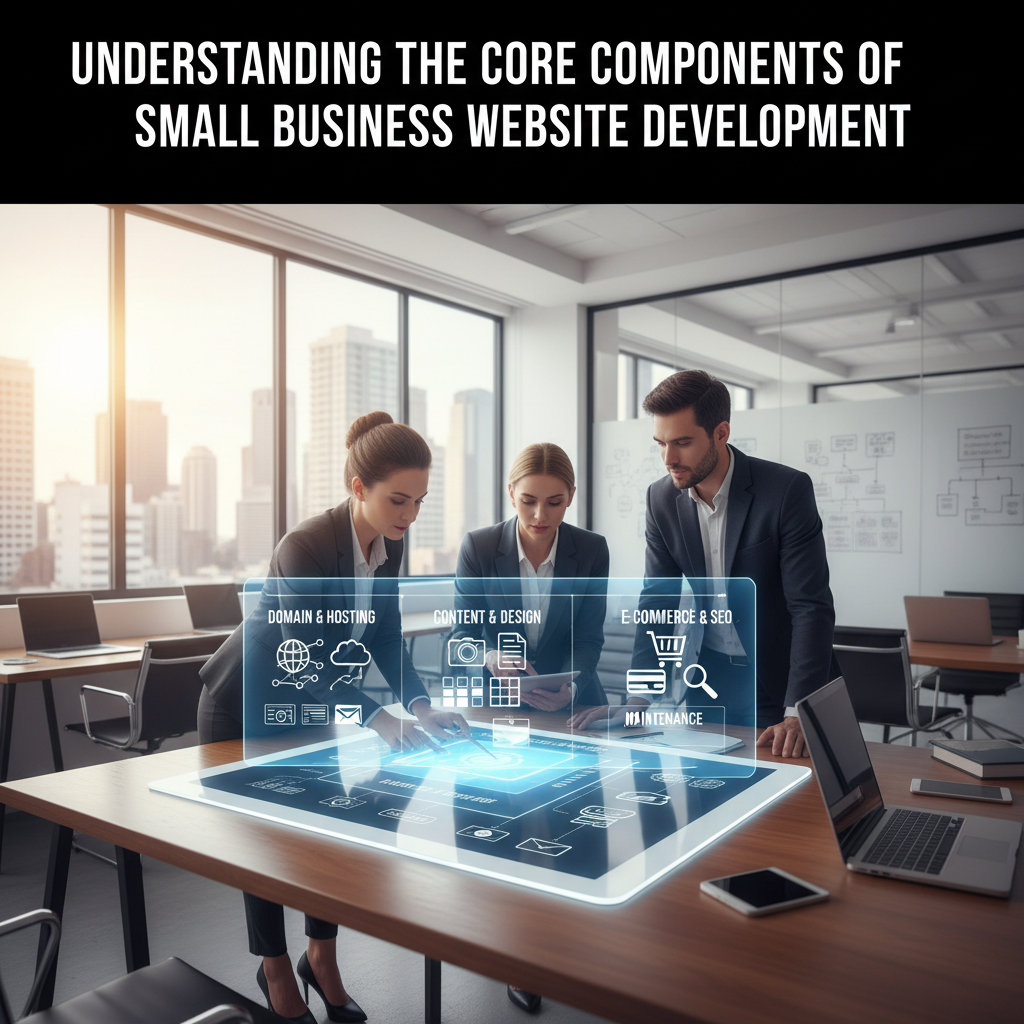
Understanding the Core Components of Small Business Website Development
Effective website development for a small business is a structured process. It involves several distinct phases, each building upon the last to create a digital asset that drives growth. Breaking down this journey into its core components—strategy, design, and technical execution—demystifies the process and ensures a successful outcome. At Dynareach, we guide our clients through each stage to build websites that are not just beautiful, but are powerful business tools.
Planning Your Website: Discovery and Strategy
The foundation of any successful website is a solid plan. This discovery and strategy phase precedes any design or coding. It begins with clearly defining your target audience: Who are you trying to reach? What are their needs and pain points? With this understanding, you can set specific, measurable goals for your site. Are you aiming to generate leads, sell products directly, or establish your brand as an industry authority?
Once your goals are set, you can develop a content strategy that maps out the pages, blog posts, and resources needed to engage your audience and guide them toward a conversion. Investing time here prevents costly backtracking later and ensures the final product is perfectly aligned with your business objectives.

Design and User Experience (UX)
With a strategy in place, the focus shifts to how the website will look and feel to your visitors. This is where design and user experience (UX) come in. The goal is to create an interface that is not only visually appealing but also intuitive and easy to use. A key element is responsive design, which ensures your site provides an optimal experience on any device, from desktops to smartphones.
Navigation should be straightforward, allowing users to find what they need with minimal clicks. Visual branding—including your logo, color palette, and typography—must be applied consistently. During this stage, a crucial decision is whether to use a pre-made template or invest in a bespoke solution, a choice that has long-term implications for flexibility and brand identity. You can learn more by exploring the differences between custom web development vs a template in our 2026 guide.
Technical Development and Implementation
This is where your vision is translated into a functional website. Development is typically split into two areas:
| Component | Responsibility |
|---|---|
| Front-End | Builds what the user sees and interacts with (layout, buttons, forms). |
| Back-End | Manages the server, database, and application logic that power the site. |
Beyond coding, this phase involves selecting a reliable hosting provider to ensure your site is fast and always online. Implementing robust security measures, such as an SSL certificate, is non-negotiable for protecting your business and your customers.
Choosing the Right Platform and Tools for Your Small Business Website
Selecting the right technology stack is a critical step in the process of website development for small business. Your choice of platform and tools will directly impact your site’s functionality, scalability, and ease of management.
Content Management Systems (CMS) Explained
A Content Management System, or CMS, is the foundational software that allows you to create, edit, and publish content without needing to code from scratch. As explained in Mozilla’s web development glossary, a good CMS enables users to collaborate on managing digital assets. For most businesses, the choice comes down to a few popular options. WordPress is a versatile powerhouse, powering a massive portion of the web with its vast library of plugins and themes. It’s an excellent choice for content-heavy sites.
E-commerce Solutions for Small Online Stores
If you plan to sell products online, you’ll need a platform with robust e-commerce capabilities. Shopify is a leading all-in-one solution built specifically for online retail, handling everything from product listings and inventory management to secure payment processing. Alternatively, WordPress can be transformed into a powerful online store using plugins like WooCommerce. When evaluating options, prioritize features like integrated payment gateways (e.g., Stripe, PayPal), automated tax calculations, and scalable inventory systems. This ensures your store can operate smoothly from your first sale to your thousandth.
Custom vs. Template-Based Development
Your next major decision is whether to use a pre-built template or invest in a custom build. Templates offer a fast, affordable way to get online but often come with limitations in design and functionality. For a website that truly performs, many businesses partner with a firm like Dynareach for a custom solution. A custom-built website provides unparalleled benefits: a unique design that reflects your brand, optimized performance for better SEO, and a scalable architecture built to grow with your business. For a deeper analysis, explore our guide on Custom Web Development vs Template: 2026 Guide. Investing in a bespoke site is the superior long-term strategy.
Essential Features for a High-Performing Small Business Website in 2026
Beyond a visually pleasing design, a successful website is a powerful business tool equipped with specific features that drive growth, engagement, and visibility. Effective website development for small business focuses on building a site that actively works for you.
Mobile-First Design and Speed Optimization
With most web traffic now on mobile, a mobile-first approach is non-negotiable. This means your website is designed for smartphones first. Google primarily uses the mobile version of a site for indexing and ranking, a standard practice known as mobile-first indexing. A clunky mobile experience leads to high bounce rates. Equally critical is loading speed. According to Google’s web.dev resources on site performance, even a one-second delay in page load time can significantly impact conversions. At Dynareach, we build every site with performance at its core, ensuring it’s blazing-fast and adheres to the latest Mobile Friendly Website Best Practices for 2026.
Search Engine Optimization (SEO) Best Practices
Your website must be built to be found. Foundational SEO ensures that when potential customers search for your offerings, your site appears in the results. This starts with on-page essentials: strategic keyword integration, unique meta titles and descriptions, and a logical heading structure (H1, H2, H3). Furthermore, incorporating structured data using Schema.org vocabulary helps search engines deeply understand your content, often rewarding you with rich results. This technical foundation is a crucial part of any professional web development project.

Security, Analytics, and Customer Engagement Tools
Trust is the currency of the internet. An SSL certificate, enabling an encrypted HTTPS connection, is mandatory. It protects user data, builds credibility, and is a confirmed signal for search rankings. To measure what matters, integrating an analytics platform like Google Analytics 4 is essential. It provides invaluable data on user behavior and conversion funnels, empowering you to make smart decisions. Finally, guide your visitors. Every page must include clear calls-to-action (CTAs) like “Contact Us” that direct users toward a valuable goal. At Dynareach, we ensure these pillars—security, analytics, and engagement—are integral to our website development for small business, transforming a simple site into a powerful growth engine.
The Strategic Advantage: How Dynareach Elevates Small Business Websites
Choosing a partner for your website development is about more than just getting a site online; it’s about building a foundational asset for growth. At Dynareach, we specialize in transforming a simple web presence into a strategic advantage that drives revenue and builds brand equity. Our approach is holistic, ensuring every line of code and design element serves a distinct business purpose.
Tailored Web Development for Ambitious Startups and SMEs
Generic templates can’t capture the unique vision of an ambitious business. That’s why Dynareach focuses exclusively on custom solutions. Whether you’re a startup launching a groundbreaking SaaS platform or a small business entering the e-commerce arena, we build from the ground up. Our process begins with understanding your specific goals, target audience, and operational needs. This allows us to architect a website that not only looks stunning but also functions as a powerful business tool, integrating seamlessly with the workflows that matter to you. This commitment to custom builds is a core part of our strategy for effective website development for small business.
Integrated SEO and Branding for Maximum Impact
A beautiful website that no one can find is a missed opportunity. Unlike agencies that treat design, SEO, and branding as separate services, we integrate them from day one. Our development process is SEO-first, meaning we build your site on a technically sound foundation designed for high performance in search engine rankings. A website’s code and structure are crucial for visibility, as confirmed by Google’s guidance on technical SEO fundamentals. We weave your brand identity into every aspect of the site, ensuring a consistent and memorable user experience that builds trust and recognition.
Ongoing Support and Scalability
Your business will evolve, and your website should be ready to evolve with it. We build websites that are fast, secure, and inherently scalable. This means as your traffic grows, your product offerings expand, or your business needs change, your website can easily adapt without requiring a costly and disruptive overhaul. We see ourselves as long-term partners, providing the ongoing support you need to manage growth effectively. This focus on future-proofing is central to our philosophy, ensuring your initial investment continues to pay dividends for years to come. Understanding website scalability for growing businesses in 2026 is key to making the right choice today.
Enabled by a robust digital foundation, your business can confidently pursue its growth objectives. Discover how our expert development services can power your success.
Budgeting for Your Small Business Website: What to Expect
Creating a budget for your small business website can feel daunting, but understanding the core components demystifies the process. An effective website is an investment, not an expense, designed to generate returns through leads, sales, and brand credibility. Planning your budget wisely ensures you allocate resources where they will have the most significant impact on your growth.
Factors Influencing Website Development Costs
The cost of website development for a small business is not a one-size-fits-all figure. It’s a sum of several critical parts. Key factors include the complexity of the design (custom vs. template), the scope of development (e.g., e-commerce functionality, user portals, API integrations), and content creation needs. Beyond the initial build, you must also account for recurring costs such as web hosting, domain registration, SSL certificates, and ongoing maintenance. For a complete breakdown, our guide on Your Website Development Cost in 2026 Revealed offers granular detail.
Understanding Different Pricing Models
Web development agencies typically use a few common pricing structures. Understanding them helps you align the engagement with your financial planning.
- Project-Based Fees: A fixed price for a clearly defined scope of work. This is ideal for businesses with a specific vision and budget, offering cost predictability.
- Hourly Rates: You pay for the actual time developers and designers spend on your project. This model provides flexibility for evolving projects but can be harder to budget for upfront.
- Retainers: A monthly fee for a set amount of ongoing work, such as updates, SEO, and technical support. A retainer model is perfect for ensuring your site remains a high-performing asset long after launch. A transparent partner like Dynareach will help you select the model that best fits your business goals.
Maximizing ROI from Your Website Investment
To maximize your return on investment, shift your focus from “How much does it cost?” to “What value will it create?” Prioritize features that directly support your business objectives. Define key performance indicators (KPIs) from the start, such as conversion rate, organic traffic, and customer acquisition cost. By tracking these metrics, you can measure your website’s success and make data-driven decisions for future improvements, ensuring every dollar you invest works toward your growth.
Frequently Asked Questions About Small Business Website Development
Navigating the world of website development can bring up many questions. Here, we answer some of the most common queries from small business owners to help clarify the process.
How long does it take to build a small business website?
The timeline for building a small business website typically ranges from 4 to 12 weeks. A simple, informational site with a few pages can be completed on the shorter end. However, a more complex project, such as an e-commerce platform with custom features or extensive third-party integrations, will naturally require more time.
Can I update my website myself after it’s built?
Yes. Modern websites are built on user-friendly Content Management Systems (CMS) like WordPress. At Dynareach, we ensure our clients can easily manage their own content. This means you can update text, add new blog posts, or swap out images without needing to write a single line of code. We provide the necessary training.
What is responsive design and why is it important?
Responsive design enables your website to automatically adjust its layout to fit any screen size. This is non-negotiable in 2026. A majority of internet users browse on mobile devices, and a poor mobile experience will drive them away. Furthermore, search engines reward mobile-friendly sites; Google’s mobile-first indexing system primarily uses a site’s mobile version for ranking and indexing.
How much does website maintenance cost?
Website maintenance is crucial for security, performance, and stability. Costs can vary, but they generally cover software updates, security monitoring, and regular backups. Many agencies, including Dynareach, offer monthly care plans. For a more detailed breakdown, you can explore our guide on Your Website Development Cost in 2026 Revealed.
Why do I need SEO for my small business website?
Search Engine Optimization (SEO) is what makes your website discoverable to potential customers searching on Google. Simply having a website isn’t enough—it needs to be visible. SEO involves optimizing your site’s content and technical structure to rank for terms your audience is searching for. A core part of our website development for small business includes building a strong SEO foundation from day one.
What is the difference between a domain name and web hosting?
Think of it this way: your domain name (e.g., yourbusiness.com) is your website’s street address. Web hosting is the physical land and building where your website’s files are stored. You need both to have a functional, accessible website.
Conclusion: Building Your Digital Future with a Powerful Small Business Website
In today’s hyper-competitive, digital-first economy, your website has become your single most powerful asset. It serves as your primary sales channel, your brand’s definitive home, and the critical first impression you make on countless potential customers. A professional, strategically built site isn’t merely about aesthetics; it’s about generating tangible results. It establishes credibility, captures high-intent leads, and creates a scalable engine for sustainable growth. For any small business aiming not just to survive but to compete and thrive, a high-performance online presence is no longer optional—it’s the very foundation upon which modern success is built.
However, launching your website marks a significant milestone, but it is just the beginning. The most successful businesses recognize that their site is not a static, one-time project but a dynamic, long-term investment that requires nurturing. The digital landscape evolves rapidly. To remain a valuable asset, your website demands continuous attention. This includes regular content updates, crucial security maintenance, and, most importantly, ongoing SEO and performance optimization. Viewing your site as an evolving part of your business ensures it adapts with you and continues to deliver a strong return.
Navigating the intricate process of professional website development for small business—from initial strategy and design to coding and launch—can feel overwhelming. This is precisely where a dedicated strategic partner becomes invaluable. At Dynareach, we specialize in translating your unique business goals into a powerful, high-performing digital platform. We go beyond just building websites; we create custom, SEO-driven experiences engineered for scalability and conversion from day one. Our comprehensive approach ensures your branding, user experience, and technical performance all work in concert to achieve tangible business outcomes.
Don’t let an outdated or underperforming website be the bottleneck that holds your business back. By entrusting your digital foundation to experts, you can focus on what you do best while your online presence works tirelessly to grow your brand. Your journey towards a commanding digital presence that drives revenue and builds loyalty starts with a single, decisive step. Ready to enable your business’s full potential and build a website that delivers real, measurable growth? Contact the Dynareach team today to book your consultation.