
Introduction: Navigating the Digital World with Web Accessibility Standards WCAG
Imagine investing heavily in a stunning new retail storefront, only to build it with impassable stairs and no ramp. A significant portion of your potential customers simply couldn’t enter. In 2026, this is precisely what happens in the digital world when a website isn’t accessible. Your online presence is your global storefront, and failing to make it usable for everyone is no longer just a missed opportunity—it’s a fundamental business flaw.
What is Web Accessibility and Why is it Essential?
Web accessibility is the inclusive practice of ensuring there are no barriers that prevent interaction with, or access to, websites on the World Wide Web by people with physical disabilities, situational disabilities, and socio-economic restrictions on bandwidth and speed. It’s about designing and developing your digital assets so that people with visual, auditory, motor, or cognitive impairments can perceive, understand, navigate, and contribute to the web.
Its importance extends far beyond an ethical imperative. An accessible website captures a wider audience, enhances your brand image as inclusive and forward-thinking, and often improves overall site performance and SEO. For all users, principles of accessible design lead to a better user experience—consider video captions used in a noisy office or high-contrast text that’s easier to read in bright sunlight. In an increasingly digital-first world, accessibility is a cornerstone of exceptional customer service.
Understanding WCAG: The Global Benchmark for Inclusive Design
The path to digital inclusivity is paved by a clear, internationally recognized framework: the web accessibility standards WCAG. The Web Content Accessibility Guidelines (WCAG) are developed through the W3C process. These guidelines provide a single shared standard for making web content more accessible.
Rather than a vague goal, WCAG offers specific, testable criteria organized around four core principles: content must be Perceivable, Operable, Understandable, and Robust (POUR). Adhering to these guidelines is the most effective way to ensure your website meets legal requirements and provides a truly equitable experience for all visitors. Building your site to meet these standards from day one, a core philosophy at Dynareach, isn’t about compliance—it’s about building a superior, more resilient, and more profitable digital presence for the future.
The Pillars of WCAG: Understanding the POUR Principles
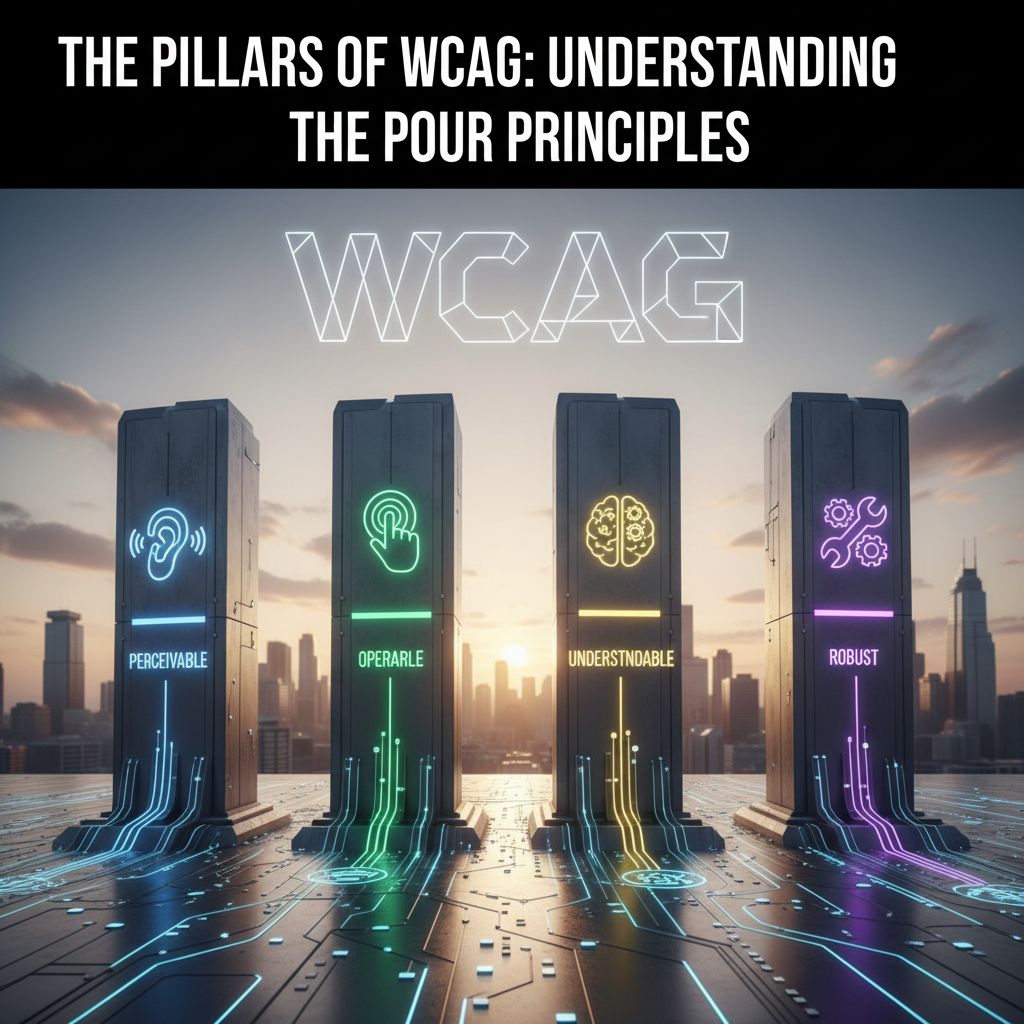
At the heart of the web accessibility standards WCAG are four foundational principles that create a framework for digital inclusion. Known by the acronym POUR, these pillars guide developers and designers toward creating websites and applications that everyone can use effectively. By building your digital presence on these principles, you not only comply with essential standards but also create a superior user experience for all.
Perceivable: Making Information Available to All Senses
For a website to be accessible, its content and information must be presentable to users in a way they can perceive. This means it cannot be invisible to all of their senses. For instance, a user who is blind needs a text alternative (alt text) to understand an image, while a user who is deaf or hard of hearing requires captions for video content. This principle also covers ensuring sufficient color contrast between text and its background so that users with low vision can read it easily.
Operable: Ensuring Easy Navigation and Interaction
Users must be able to navigate and interact with your website’s components. The interface cannot require an interaction that a user is unable to perform. A critical aspect of this is full keyboard accessibility, meaning every function, from navigating menus to submitting forms, can be accomplished without a mouse. Other key considerations include providing users enough time to read and use content and avoiding flashing content that could induce seizures.

Understandable: Clarity and Predictability in Web Content
It’s not enough for users to perceive and operate your site; they must also be able to understand the information and the user interface. This principle emphasizes clarity and predictability. Using plain language, maintaining a consistent navigation structure across pages, and providing clear instructions and error messages for forms are all practical applications of this pillar. Strong, user-centric design is fundamental to making a website understandable, a core focus of modern UI UX design trends.
Robust: Compatibility Across Diverse Technologies
Your content must be robust enough to be interpreted reliably by a wide variety of user agents, including web browsers and assistive technologies like screen readers. This is about future-proofing. As technology evolves, a robust website will remain accessible. The most effective way to achieve this is through clean, valid code (like HTML and CSS) that follows established standards. At Dynareach, we prioritize building websites with a robust foundation, ensuring they work seamlessly with current and future technologies, providing lasting value and reach.
WCAG Conformance Levels: A, AA, and AAA Explained
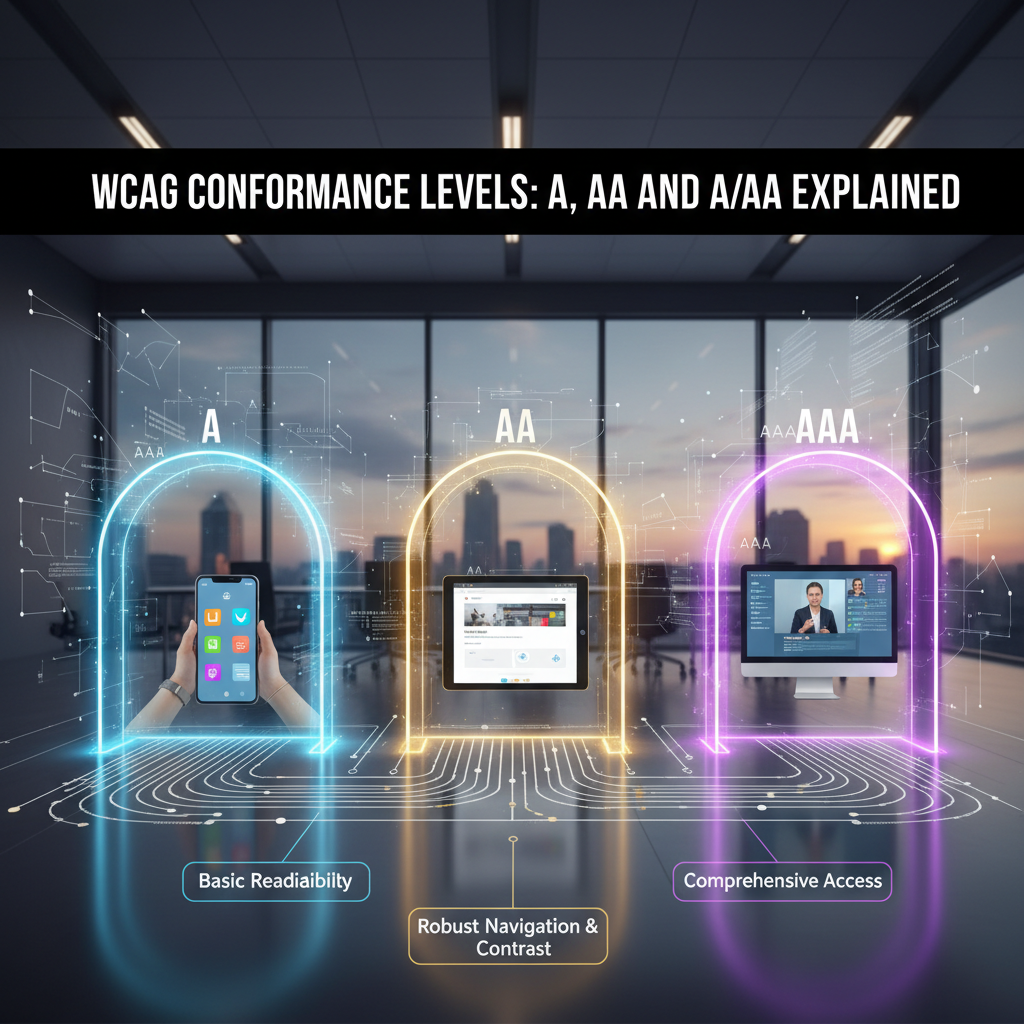
The Web Content Accessibility Guidelines (WCAG) are organized into three conformance levels: A, AA, and AAA. Think of them as progressive tiers, with each level building upon the requirements of the one before it. Understanding these levels is crucial for setting realistic and impactful goals for your website’s accessibility and overall user experience.
Deciphering A, AA, and AAA: What Each Level Means
Each conformance level represents a different degree of accessibility, addressing a wider range of user needs as you ascend the tiers.
- Level A: This is the most basic level of web accessibility. Conformance at this level addresses the most critical barriers for users with disabilities. For example, a Level A criterion requires providing text alternatives for non-text content. While achieving Level A is a crucial first step, it is generally considered the absolute minimum.
- Level AA: This level is the global standard and the target for most organizations. It addresses the most common and significant barriers to accessibility, making content usable for a broad audience. Level AA conformity is often the benchmark cited in accessibility legislation around the world. It includes criteria like ensuring sufficient color contrast between text and background, and providing visible focus indicators for keyboard navigation.
- Level AAA: This is the highest and most stringent conformance level. It requires a significant commitment to making your website accessible to the widest possible range of users. Criteria at this level include providing sign language interpretation for media. While admirable, achieving full AAA compliance across an entire website is often not practical or necessary for most businesses.
Determining the Right Conformance Level for Your Business
For the vast majority of businesses, Level AA is the target. It represents the industry best practice and satisfies most legal requirements, striking a balance between creating a highly accessible user experience and practical implementation. While Level A is a non-negotiable starting point, stopping there leaves you vulnerable to legal risks and excludes large segments of your potential audience.
Your specific goals should guide your decision. A government agency might strive for Level AAA on critical pages. For a startup or SaaS company, a robust Level AA conformance across the entire site is a strong, defensible goal. Implementing these web accessibility standards WCAG involves development effort, which should be factored into your project scope, a factor explored in our custom web development cost breakdown. At Dynareach, we help businesses navigate these standards to build websites that are not only compliant but also highly effective.
Implementing WCAG: Practical Steps for Accessible Web Development
Adhering to web accessibility standards WCAG isn’t just a final compliance check; it’s a foundational principle that should be woven into every stage of your website’s lifecycle. A proactive approach not only ensures a better experience for all users but also prevents costly and time-consuming retrofits down the line.
Designing for Accessibility from the Ground Up
The most effective way to build an accessible website is to start at the very beginning: the design phase. Before a single line of code is written, designers should consider color contrast ratios for readability, choose legible fonts, and create logical, predictable navigation layouts. This “accessibility-first” mindset ensures that the core structure is inclusive. At Dynareach, we integrate these principles into every project, building a strong foundation that supports every user. A custom-built site often provides the flexibility needed to implement these features without the constraints of a template, a crucial factor when considering your development path. For more on this, see our guide on custom web development vs. platform solutions.
Content Creation Best Practices for WCAG Compliance
Your site’s structure can be perfect, but inaccessible content will still create barriers. Every team member involved in content creation must understand their role in maintaining accessibility. This includes:
- Writing descriptive alt text for all meaningful images.
- Providing accurate captions and transcripts for video and audio content.
- Using clear and simple language, avoiding jargon where possible.
- Structuring content with proper heading hierarchies (H1, H2, H3) to facilitate navigation for screen reader users.
Tools and Technologies to Aid in Accessibility
A variety of tools can help you test and improve your site’s accessibility. Browser extensions and automated testing platforms can quickly scan your site for common WCAG violations, such as missing alt text or low contrast. However, these tools can’t catch everything. Manual testing, including navigating your site with a keyboard only and using a screen reader, is essential for uncovering usability issues that automated tools miss. While these tools are helpful, the most reliable approach is partnering with experts. The team at Dynareach combines automated tools with rigorous manual testing and expert review, providing a comprehensive audit and implementation service that guarantees your digital presence is truly open to everyone.
The Business Case for Accessibility: Beyond Compliance
In 2026, viewing web accessibility as merely a compliance checkbox is a critical business mistake. Forward-thinking companies now recognize that adhering to web accessibility standards WCAG is a powerful driver of growth, innovation, and brand loyalty. The conversation has shifted from “Do we have to?” to “How can this unlock our potential?” The tangible benefits are too significant to ignore, while the legal and financial risks of non-compliance have never been higher.
Expanding Your Reach and Improving SEO
An accessible website is, by definition, a website that more people can use. By designing for users with disabilities, you instantly expand your potential market to millions of individuals who rely on assistive technologies.
The technical requirements of accessibility directly overlap with SEO best practices. Search engine crawlers function similarly to screen readers; they parse your site’s structure and content to understand its meaning. Properly structured headings, descriptive alt text for images, and logical navigation are signals of a high-quality, user-friendly site for both Google and users with disabilities. An accessible foundation is a crucial part of any modern SEO for New Website Launch Checklist 2026.
Boosting Brand Reputation and User Experience
A public commitment to accessibility sends a powerful message: your brand is inclusive, modern, and cares about every user. This fosters significant goodwill and builds a loyal community around your business. In an era where consumers align with brands that share their values, inclusive design is a key differentiator. At Dynareach, we have seen firsthand how a human-centered approach to development translates into a stronger brand story.
Furthermore, accessibility enhances the user experience for everyone. Features like high-contrast text, clear layouts, and keyboard-navigable menus—all core to web accessibility standards WCAG—create a more intuitive and less frustrating experience for all visitors. This universal usability reduces bounce rates and increases conversions. Ready to enable your brand’s full market potential? Discuss your accessibility strategy with Dynareach today.
Partnering for Success: Dynareach and Your Accessibility Journey
Navigating the complexities of digital accessibility can feel overwhelming, but you don’t have to do it alone. True digital inclusivity goes beyond compliance checklists; it involves a strategic commitment to creating seamless experiences for every user. At Dynareach, we partner with businesses to transform accessibility from a challenge into a core strategic advantage, ensuring your digital presence is both compliant and exceptionally effective.
Dynareach’s Expertise in WCAG-Compliant Website Development
Achieving lasting compliance requires more than a simple plugin or an automated scan. It demands expertise woven into the very fabric of your website’s design and code. The team at Dynareach are specialists in building custom websites from the ground up with the web accessibility standards WCAG as a foundational blueprint. Whether we are developing a sophisticated SaaS platform, a high-volume e-commerce store, or a dynamic corporate site, accessibility is integrated at every stage, from initial wireframes to final deployment. This proactive approach ensures that crucial elements like semantic HTML, ARIA labels, keyboard navigability, and color contrast are correctly implemented from the start, preventing costly retrofitting later. We build accessible experiences that are robust, scalable, and intuitive for all users.
Comprehensive Solutions for Startups and Established Businesses
Our approach is tailored to your unique needs. For new ventures, we lay a compliant foundation that supports future growth. For established businesses, we begin with a comprehensive accessibility audit of your existing digital assets, identifying specific points of non-conformance with the latest web accessibility standards WCAG. We then deliver a clear, actionable remediation roadmap and provide the development resources to implement these fixes efficiently.
However, our partnership doesn’t end at launch or remediation. We understand that a website is a living entity. That’s why we offer ongoing support and training to help your team maintain compliance as new content is added. At Dynareach, we see accessibility as a critical component of a holistic digital strategy. It enhances your SEO, strengthens your brand’s reputation, and improves the overall user experience for every visitor. By choosing the right partner, you ensure your commitment to accessibility is powerfully realized. Discover more about what to look for in a digital partner in our guide on how to choose a web design agency.
Frequently Asked Questions About Web Accessibility Standards WCAG
Navigating the landscape of digital compliance can be complex. Here are answers to some of the most common questions businesses have about web accessibility and the WCAG framework in 2026.
What exactly is WCAG and why is it important?
WCAG stands for Web Content Accessibility Guidelines. It’s a globally recognized set of technical standards for making web content more accessible to people with a wide range of disabilities. In 2026, its importance is non-negotiable. Adhering to WCAG not only demonstrates social responsibility and inclusivity but also unlocks a larger market share and mitigates legal risks.
What are the main benefits of making my website WCAG compliant?
The benefits are extensive. Beyond expanding your audience to include the millions of users with disabilities, you’ll improve your overall user experience, boost your brand’s reputation, and strengthen your SEO. A well-structured, accessible site often leads to better engagement metrics and higher customer loyalty.
Which WCAG conformance level (A, AA, or AAA) is right for my business?
For most businesses, Level AA is the target. Level A is the bare minimum and may not be sufficient for legal protection. Level AA strikes the right balance between robust accessibility and practical implementation. Level AAA is the highest standard, typically reserved for specialized services or government portals dedicated to accessibility.
Can WCAG compliance improve my website’s SEO?
Absolutely. There’s significant overlap between accessibility and SEO best practices. Features required for WCAG compliance, such as alt text for images, logical heading structures, and descriptive link text, are all strong signals for search engines. This synergy means that investing in accessibility directly supports your efforts to master your rankings.
How long does it typically take to make a website WCAG compliant?
The timeline varies based on your website’s size, complexity, and current state. A small brochure site might be remediated in a few weeks, while a large e-commerce platform could take several months. A qualified partner like Dynareach can perform an audit and provide a detailed project scope and timeline.
What are the legal implications of not having an accessible website?
In 2026, the legal risks are substantial and growing. Many countries have laws that mandate digital accessibility, and lawsuits citing WCAG as the benchmark for compliance are increasingly common and costly. Proactive compliance is the best defense.
How can Dynareach help my business achieve WCAG compliance?
At Dynareach, accessibility isn’t an afterthought—it’s part of our development DNA. We build websites from the ground up with the web accessibility standards WCAG integrated into every phase. From initial design to final code, we ensure your site meets Level AA conformance, providing a seamless, compliant, and user-friendly experience for everyone.
Conclusion: Building an Inclusive Digital Future with WCAG
The journey through the principles and guidelines of web accessibility ultimately leads to a simple, powerful truth: the internet should be for everyone. Web accessibility is the fundamental practice of digital empathy and a core pillar of a modern, equitable society. The Web Content Accessibility Guidelines (WCAG) provide the globally recognized framework for turning this principle into a tangible reality. By offering a clear, actionable roadmap, these standards empower developers, designers, and business owners to break down digital barriers and create experiences that are open to all users, regardless of their physical or cognitive abilities.
Adhering to these standards yields profound benefits that ripple across your entire organization. For users, it means the freedom to independently access information, engage with services, and participate in online communities. For your business, the advantages are equally compelling. You unlock access to a wider market segment, enhance your brand’s reputation as an inclusive and forward-thinking company, improve your SEO performance through best practices, and mitigate significant legal and financial risks associated with non-compliance. Embracing the web accessibility standards WCAG is a clear win-win, aligning ethical responsibility with strategic business growth.
Navigating the detailed requirements of WCAG can be a complex undertaking, requiring deep technical expertise and a commitment to ongoing maintenance. This is not a journey you have to take alone. For startups and established businesses dedicated to getting it right from the start, partnering with an expert is the most effective path forward. At Dynareach, we integrate accessibility into the core of our web development and branding services. We believe a successful website is one that is built for every user, ensuring your digital presence is not just compliant, but truly inclusive.
Don’t let accessibility be an afterthought. Make it the cornerstone of your digital strategy to build a website that welcomes everyone. If you are ready to build an inclusive, high-performing, and compliant online presence, let Dynareach enable your vision.