
Introduction: Ensuring a Flawless Technical SEO Website Launch in 2026
Imagine the scene: after months of meticulous design, development, and content creation, your stunning new website finally goes live. You wait for the traffic, the leads, the sales… but they never come. A quick search on Google reveals the horrifying truth: your site is nowhere to be found. This isn’t a bad dream; it’s the all-too-common reality for businesses that neglect the technical foundation of their digital debut. Launching a website without a solid technical SEO strategy is like building a beautiful skyscraper on a foundation of sand—it’s destined to falter.
The Critical Role of Technical SEO in Website Launches
Technical SEO is the unseen framework that helps search engines like Google find, crawl, index, and understand your website’s content. For a brand-new site, this first impression is everything. You are essentially introducing your digital property to the world’s largest search engine, and you want that introduction to be clear, confident, and compelling. When done correctly, your site signals that it is fast, secure, mobile-friendly, and logically structured, making it easy for search engine bots to navigate and rank your pages.
Conversely, a launch plagued by technical errors sends all the wrong signals. Issues like slow page load speeds, broken links, or incorrect indexing commands can prevent your site from ever appearing in search results, rendering your investment in design and content virtually worthless. At Dynareach, we’ve seen firsthand how a technically sound launch can create immediate momentum, while a flawed one can take months of costly, reactive fixes to correct.
Why a Checklist is Essential for Success
The pre-launch phase is often a whirlwind of activity, making it incredibly easy for crucial details to slip through the cracks. Did you remove the ‘noindex’ tag that blocked the entire site during development? Is your XML sitemap submitted and error-free? Have you implemented 301 redirects from old URLs? Forgetting even one of these steps can have significant negative consequences.
This is where a systematic approach becomes invaluable. A comprehensive technical SEO checklist website launch transforms a potentially chaotic process into a structured, repeatable, and foolproof plan. It serves as your pre-flight inspection, ensuring every critical component is checked, double-checked, and optimized before you go live. Following a detailed checklist is the single most effective way to prevent costly mistakes, ensure a smooth transition, and set your new website on a path to long-term organic growth from day one.
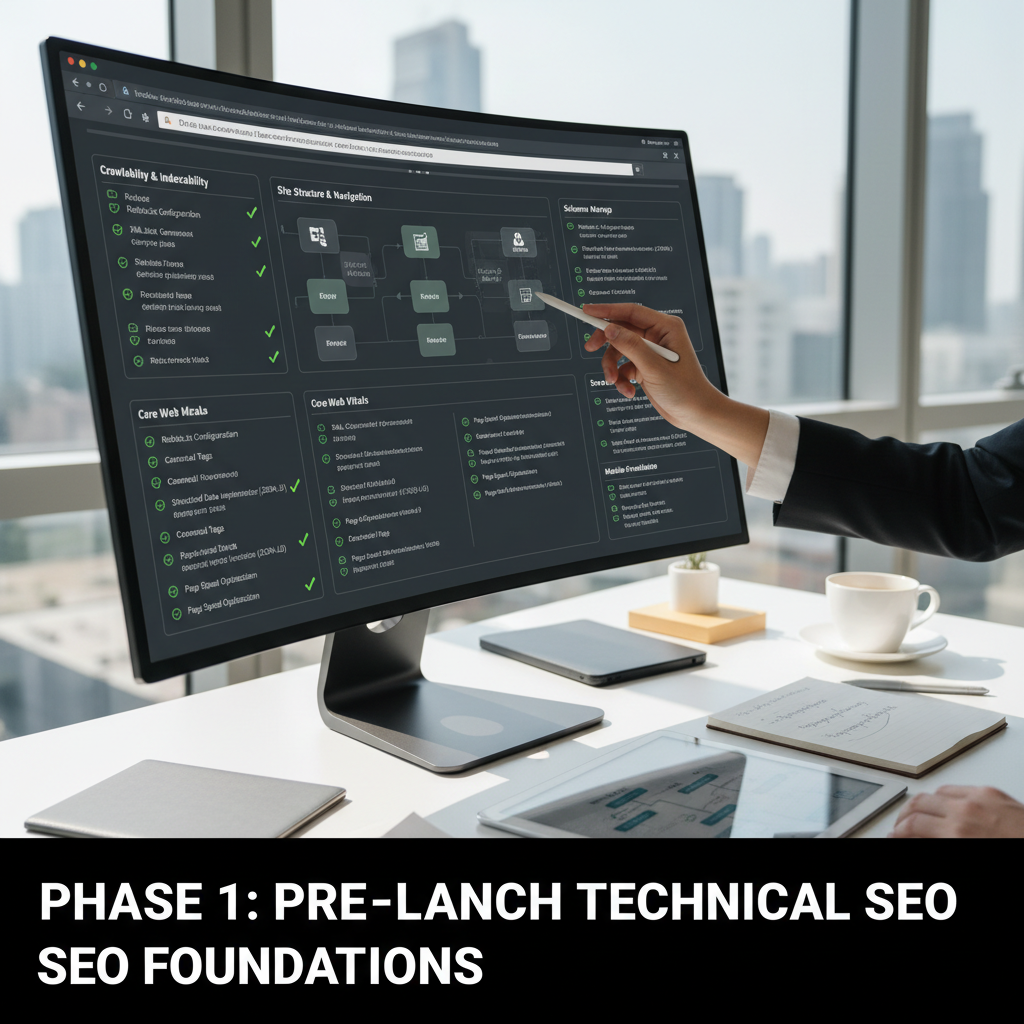
Phase 1: Pre-Launch Technical SEO Foundations
Before a single page of your new website is live, the most crucial work begins. The pre-launch phase is where you build the bedrock of your site’s long-term SEO potential. Overlooking these initial steps is a common mistake, but a thorough technical SEO checklist for a website launch always prioritizes this foundational work to prevent costly fixes down the road. Getting this stage right sets the tone for your entire digital presence.
Choosing the Right Domain and Hosting
Your domain name is your digital address, and your first major branding decision. While keyword-rich domains were once a popular tactic, modern SEO favors brandable, memorable names that are easy to spell and recall. A unique domain like dynareach.co is far more powerful for building a lasting brand than a generic, keyword-stuffed alternative.
Equally important is the engine that powers your site: your hosting. Don’t let a slow, unreliable host sabotage your launch before it even starts. Slow load times frustrate users and signal low quality to search engines, directly impacting your ability to rank. Invest in a high-performance hosting solution that guarantees speed, provides robust security (including a free SSL certificate for HTTPS), and has a proven track record of near-perfect uptime.

Website Architecture and URL Structure
A logical website structure acts as a clear roadmap for both your visitors and search engine crawlers. Before building any pages, map out a shallow, intuitive hierarchy that groups related content into categories (often called “silos”). This not only improves user experience but also helps search engines understand the thematic relationships between your pages, which is vital for topical authority.
This clean structure should be directly reflected in your URLs. Best practices for 2026 and beyond demand URLs that are:
- Short and descriptive: Use keywords naturally.
- Easy to read: Use lowercase letters and hyphens to separate words.
- Logical: Follow the site’s hierarchy.
For example, a URL like yoursite.com/services/web-design is vastly superior to a messy, parameter-driven one like yoursite.com/page.php?id=87. At Dynareach, we design and implement this logical architecture from day one, ensuring every client site is scalable and built on an SEO-friendly foundation.
Setting Up Google Search Console and Analytics
Phase 2: On-Page Technical Optimizations for Launch
With your site’s architecture planned, the next critical phase involves optimizing the on-page elements that search engines and users see first. These are the foundational signals that communicate your content’s relevance, quality, and purpose directly to Google. Mastering this stage is non-negotiable for a successful technical SEO checklist website launch, as it builds the context crawlers need to correctly rank your pages from day one. For more insights, see built-in on-page SEO tools.
Meta Data Optimization
Your metadata is your digital first impression on search engine results pages (SERPs). Think of it as the billboard for your webpage.
- Title Tags: As a core ranking factor, your title tag needs to be strategic. Include your primary keyword, ideally near the beginning, and keep the title within a 55–60 character range to prevent it from being cut off in search results.
- Meta Descriptions: While not a direct ranking factor, your meta description is a vital sales pitch that heavily influences whether a user clicks on your link. Write persuasive copy that summarizes the page’s value and includes a call to action, all within about 155 characters.
- Image Alt Text: Every meaningful image needs descriptive alt text. This serves two key purposes: it makes your site accessible to visually impaired users relying on screen readers, and it helps search engines understand the image’s context, which can drive valuable traffic from image search.
Crawlability and Indexability Directives
You must guide search engine crawlers through your new site with clear instructions. Your robots.txt file acts as a traffic controller, using Disallow directives to tell bots which areas to avoid, such as admin login pages or parameter-heavy URLs that create duplicate content. For individual pages you want bots to crawl but not show in search results (like thank you pages or internal search portals), the noindex meta tag is the proper tool. Finally, generate and submit an XML sitemap via Google Search Console. This roadmap lists all your important URLs, helping search engines discover and index your content much faster after launch.
Schema Markup Implementation
Phase 3: Performance and User Experience (UX) Enhancements
Once your site is crawlable and indexable, the focus shifts to how real users and search engines perceive it. This phase is critical because a technically sound site that is slow, insecure, or unusable on mobile will fail to retain visitors and rank well. Performance and user experience are foundational pillars in any modern technical SEO checklist website launch. These elements directly impact how your audience engages with your content and how Google evaluates your site’s quality.
Website Speed and Core Web Vitals
In 2026, site speed isn’t a suggestion; it’s a requirement. Slow-loading pages frustrate users, leading to high bounce rates and signaling a poor experience to Google. Your goal is to optimize for Core Web Vitals, Google’s specific metrics for measuring loading performance, interactivity, and visual stability. Nailing these metrics often involves complex tasks like code minification and server configuration. Key actions include:
- Image Optimization: Compress images without losing visual quality and serve them in next-gen formats like WebP or AVIF.
- Browser Caching: Instruct browsers to store static assets (like your logo and CSS files) locally, so they don’t have to be re-downloaded on subsequent visits.
- Code Minification: Remove unnecessary characters and spaces from HTML, CSS, and JavaScript files to reduce their size.
Use Google’s PageSpeed Insights to test your pages against these official benchmarks.
| Core Web Vital Metric | What It Measures | Ideal Target |
|---|---|---|
| Largest Contentful Paint (LCP) | Loading performance | Under 2.5 seconds |
| Interaction to Next Paint (INP) | Overall responsiveness and interactivity | Under 200 milliseconds |
| Cumulative Layout Shift (CLS) | Visual stability of the page | A score under 0.1 |
Mobile-Friendliness and Responsive Design
Google operates on a mobile-first indexing model, meaning it primarily uses the mobile version of your site for indexing and ranking. Therefore, a responsive design that adapts seamlessly to all screen sizes is non-negotiable. This goes beyond simply shrinking your desktop site. It means ensuring text is readable without zooming, buttons are easily tappable with a thumb, and navigation is intuitive on a small screen. Test your design rigorously on actual smartphones and tablets, not just browser emulators, to catch real-world usability issues before your go-live date.

Secure Sockets Layer (SSL) Implementation
Phase 4: Post-Launch Monitoring and Refinement
Launching your new website is an exhilarating milestone, but the work doesn’t stop once you press “go live.” This is where the crucial post-launch phase begins—a period of diligent monitoring and refinement to ensure your initial efforts translate into sustained growth. What happens in the weeks following your launch will set the tone for your site’s long-term performance and SEO success.
Monitoring Rankings and Traffic
Immediately after launch, your focus should shift to tracking performance. The two most essential tools for this are Google Search Console (GSC) and Google Analytics (GA). Think of them as the diagnostic dashboard for your website’s health.
GSC provides invaluable insights into how Google perceives your site, tracking indexing status, mobile usability, and search performance metrics like clicks and impressions. It’s your direct line of communication with the search engine. Meanwhile, GA tells you what users do once they arrive, revealing traffic sources, user engagement, and conversion paths. By monitoring these platforms daily, you can quickly gauge the impact of your launch and establish a performance baseline. The team at Dynareach always integrates these tools from day one to provide a clear picture of post-launch success.
Identifying and Fixing Crawl Errors
Even the most meticulously executed technical SEO checklist website launch can result in unexpected issues. Regular monitoring of GSC’s Coverage report is non-negotiable. This report will alert you to critical problems that can hinder your SEO, including:
- 404 (Not Found) Errors: These broken links frustrate users and waste Google’s crawl budget. They must be fixed promptly by implementing 301 redirects to the correct pages.
- Server Errors (5xx): These indicate a problem with your hosting environment and require immediate investigation.
- Duplicate Content: GSC flags duplicate meta descriptions or titles, which can dilute your ranking signals. Addressing these with canonical tags is essential for consolidating SEO value.
Continuous Optimization with Dynareach
Phase 5: Advanced Technical SEO Considerations
Once the foundational elements are in place, your technical SEO checklist website launch must address more advanced configurations. These considerations are crucial for maximizing your site’s reach, preserving its authority, and ensuring efficient indexing from day one. Getting these right sets the stage for sustainable growth and a superior user experience.
International SEO Setup
If your brand targets audiences across different countries or languages, implementing a precise international SEO strategy is essential. The core of this is the hreflang attribute. This HTML tag signals to search engines which language and regional version of a page to serve to a user. For example, it tells Google to show your-site.com/ca/ to Canadian users and your-site.com/au/ to Australian users, even if both pages are in English. Correctly implemented hreflang tags prevent cannibalization between your international pages and deliver a more relevant experience, which is a powerful ranking signal in 2026.
Managing Redirects (301s)
When launching a new site, especially if it replaces an old one, you are likely changing URL structures. This is where 301 redirects become your most important tool for preserving SEO value. A 301 redirect is a permanent instruction that seamlessly sends users and search engine crawlers from an old URL to its new equivalent. This process passes the vast majority of the original page’s link equity (or “SEO juice”) to the new page, safeguarding your search rankings. Meticulously mapping every legacy URL to a relevant new page and implementing these redirects before launch prevents broken links and protects your domain authority.
XML Sitemap Best Practices
An XML sitemap acts as a direct line of communication with search engines, providing a clear roadmap of all the URLs you want them to crawl and index. A best-practice sitemap is clean and purposeful. It should only contain final, indexable URLs that return a 200 OK status code. Crucially, you must exclude any pages that are noindexed, password-protected, or redirected. Including these sends conflicting signals and can waste crawl budget. Once your sitemap is generated, submit its location in your robots.txt file and directly to Google Search Console and Bing Webmaster Tools to accelerate the discovery of your new site. The team at Dynareach consistently finds that a well-maintained sitemap is a key factor in a swift and successful indexing process post-launch.
Frequently Asked Questions About Technical SEO Website Launches
Navigating a technical SEO checklist website launch can bring up many questions. Here are answers to some of the most common ones to ensure your new site has a strong technical foundation from day one.
Common Technical SEO Mistakes to Avoid?
The most frequent launch-day errors are often the most damaging. These include forgetting to create and submit an XML sitemap to Google, misconfiguring the robots.txt file to accidentally block crawlers from important pages, and failing to implement 301 redirects from old URLs to new ones. Another major pitfall is neglecting mobile optimization; in 2026, a site that isn’t responsive and fast on mobile devices will struggle to rank.
How Often Should I Audit My Technical SEO?
A full technical audit is a mandatory step before your website goes live. After launch, conduct a follow-up audit within 30 days to identify and fix any unexpected issues. Beyond that, a quarterly technical audit is a best practice for most active websites. For smaller, static sites, a bi-annual check-up may suffice, but any major site update or redesign should always be preceded by a thorough audit.
What Role Does Hosting Play in Technical SEO?
Your web hosting is a cornerstone of technical SEO. A slow hosting provider directly impacts server response times, which is a key component of Google’s Core Web Vitals. Frequent downtime makes your site unreliable for both users and search engine crawlers, potentially leading to de-indexing. Even the physical location of your server matters, as it can affect loading speeds for your primary user base and influence local search signals.
Can I Do Technical SEO Myself, or Should I Hire an Agency?
While business owners can manage basic technical elements on user-friendly platforms, executing a flawless technical SEO checklist website launch requires deep expertise. Complexities like schema markup, international SEO, and site migrations often necessitate a specialist. Partnering with an expert agency like Dynareach ensures that critical details aren’t missed, preventing costly ranking drops and helping you achieve visibility faster.
What Tools Are Essential for Technical SEO?
A few tools are vital. Google Search Console is non-negotiable for monitoring your site’s health and indexation status. A site crawler like Screaming Frog SEO Spider is essential for finding broken links, analyzing page titles, and auditing redirects. For performance analysis, tools like GTmetrix and Google’s PageSpeed Insights are indispensable for measuring and improving site speed.
Conclusion: Launch Your Website with Confidence and Strong Technical SEO
Launching a new website is a monumental step, but the real work lies in ensuring it’s built on a foundation that will attract and delight both search engines and users. A successful launch isn’t just about going live; it’s about going live with a clear strategy for long-term visibility and performance. This is where meticulous technical SEO becomes your most valuable asset, transforming a simple launch into a strategic business advantage.
Recap of Key Technical SEO Principles
As we’ve explored, a comprehensive technical SEO checklist website launch is non-negotiable. This process ensures all critical signals are correctly configured from the very beginning. It starts with proper domain setup and fast, reliable hosting. From there, it dives deep into ensuring search engines can efficiently crawl and index your content through optimized robots.txt files, logical sitemaps, and correct use of canonical tags. Prioritizing site speed and Core Web Vitals guarantees a positive user experience, while mobile-first design and HTTPS security build trust and cater to modern audience expectations. Getting these elements right prevents the need for costly, disruptive fixes down the road.
The Long-Term Benefits of a Solid Foundation
Investing in technical SEO before you launch pays dividends for years to come. A technically sound website is rewarded by search engines with better rankings and sustained visibility, creating a reliable stream of organic traffic. For users, this translates into a seamless, fast, and secure experience that encourages them to stay longer, engage more deeply, and convert. This strong foundation not only improves your search performance but also amplifies the impact of all your other marketing efforts, from content creation to paid advertising. For an organization aiming for sustainable growth, getting the technical details right isn’t optional—it’s the core of a successful digital strategy. A flawless execution of your technical SEO checklist website launch is what separates a site that simply exists from one that excels.
The complexity of these tasks can be daunting. That’s where an expert partner can make all the difference. At Dynareach, we specialize in building websites engineered for peak performance from day one. Enable your brand’s digital future with a launch that’s technically perfect. Contact the experts at Dynareach to ensure your website launches with a competitive edge.