
A Pragmatic Guide to Custom Software Development for Enterprises
Custom enterprise software development is the process of designing, building, and deploying applications specifically for the unique operational needs of a large organization, rather than using off-the-shelf products. The goal is to create a system that perfectly aligns with your workflows, security protocols, and scalability requirements, giving you a distinct competitive advantage. A typical project cost can range from $50,000 to over $500,000, depending on complexity, but delivers a tangible return by solving problems that generic software cannot address, directly impacting efficiency and long-term growth.
To create this guide, we analyzed the common pitfalls and success factors observed across hundreds of enterprise-level software projects. The criteria for what makes a successful approach are ranked based on their impact on long-term ROI, security, and user adoption. This isn’t a theoretical exercise; it’s a reflection of what works in practice, drawing from our experience building solutions from complex e-commerce stores to bespoke SaaS platforms for clients.

Why Choose Custom Development Over Off-the-Shelf?
Off-the-shelf software, like a generic CRM or project management tool, is built for the masses. It solves common problems for the average business but often forces your unique processes into a predefined box. This leads to workarounds, inefficient data handling, and a patchwork of integrations that are prone to breaking. The initial cost savings are often eroded by subscription fees, feature limitations, and the inability to adapt to your company’s specific needs as it scales. According to Gartner, custom software development services are engaged by organizations to “meet their unique business needs,” a clear acknowledgment that one-size-fits-all solutions fall short for complex enterprises.
Custom enterprise software development, by contrast, is a strategic investment in a proprietary asset. The application is built around your exact specifications, integrating perfectly with your existing systems and providing a seamless experience for your employees and customers. It’s the difference between buying a suit off the rack and having one tailored. The tailored suit fits perfectly, moves with you, and is made from materials you chose. It’s an investment that pays dividends in performance and longevity.
Types of Custom Enterprise Software
Enterprise software isn’t a single category; it’s a broad term for business-oriented tools designed to improve efficiency and manage complex operations. While the possibilities are nearly endless, most custom projects fall into several key categories.
- Enterprise Resource Planning (ERP): ERP systems are the central nervous system of a large organization. They integrate core business processes: finance, HR, manufacturing, supply chain, services, and procurement. A custom ERP allows a business to build a system around its specific financial reporting standards, supply chain logic, or manufacturing workflows, something a generic solution like NetSuite or SAP can struggle to accommodate without extensive, costly customization.
- Customer Relationship Management (CRM): While products like Salesforce dominate the market, many enterprises have customer lifecycle or data privacy requirements that generic CRMs can’t meet. A custom CRM can integrate unique data sources, automate proprietary sales processes, and ensure compliance with industry-specific regulations like HIPAA or GDPR in ways that an off-the-shelf product simply cannot. For our client Wolverine Assemblies, a custom-tuned digital strategy was key to a major increase in qualified leads.
- Document Management Systems (DMS): For industries like law, finance, and healthcare, managing millions of documents with strict security and compliance rules is a daily challenge. A custom DMS can enforce unique access control logic, integrate with specialized hardware like scanners or printers, and automate complex document routing and approval workflows that are specific to the organization’s legal or operational mandates.
- Business Intelligence (BI) & Analytics Platforms: Enterprises collect vast amounts of data. Custom BI platforms can pull data from disparate, often proprietary, sources (from factory floor sensors to legacy financial systems) and apply custom algorithms to generate insights specific to that company’s market position. This goes beyond the pre-built dashboards of tools like Tableau or Power BI, enabling predictive analytics tailored to your business model.
- Industry-Specific Solutions: Many industries have needs that are entirely unmet by packaged software. A logistics company might need a custom platform to manage a fleet of autonomous vehicles. A biotech firm may require a unique application to manage clinical trial data in compliance with FDA regulations. In these cases, custom development isn’t just an option; it’s the only path forward.
The Custom Software Development Lifecycle
Building enterprise-grade software is a structured, multi-stage process. Skipping or rushing a phase is the most common reason projects fail, go over budget, or result in a product that users refuse to adopt. Every successful project follows a disciplined path from idea to implementation and beyond.
1. Discovery and Planning
This is the most critical phase. It involves deep collaboration between your stakeholders and the development team to define the “what” and the “why.” What problem are we solving? Who are the users? What are the precise business requirements, technical constraints, and success metrics? This stage produces key documents like a project charter, a statement of work (SOW), and a preliminary roadmap. Rushing this stage is a false economy; a week of planning can save months of rework. In fact, a reported 70% of projects fail due to a lack of requirements gathering, a statistic from Gitnux that underscores the importance of this initial step.
2. UI/UX Design
Enterprise software is often complex, but its interface doesn’t have to be. The UI/UX (User Interface/User Experience) phase translates the requirements into tangible wireframes, mockups, and interactive prototypes. The goal is to design a system that is intuitive, efficient, and requires minimal training. This phase is user-centric, involving feedback loops with the people who will actually use the software every day. A beautiful interface is nice, but an intuitive one that reduces clicks and prevents errors is what drives adoption and ROI.
3. Architecture and Development
With a clear design in hand, the engineering team designs the system architecture. This is the blueprint for the software, defining the technology stack (e.g., programming languages, databases, cloud services), data model, and security framework. Following architectural sign-off, the development sprints begin. Using Agile methodologies, the project is broken down into small, manageable chunks, with features built, tested, and demonstrated in regular cycles. This iterative process allows for flexibility and ensures the project stays aligned with business goals.
The choice of architecture isn’t just a technical detail; it dictates the software’s ability to scale, its resilience to threats, and the total cost of ownership over its lifetime. A monolithic architecture might be faster to build initially, but a microservices approach often provides better long-term flexibility.
4. Quality Assurance (QA) and Testing
Parallel to development, the QA team works to break the software. They conduct a battery of tests: functional testing (does it do what it’s supposed to?), performance testing (does it handle load?), security testing (can it be compromised?), and usability testing (is it easy to use?). A rigorous QA process is non-negotiable for enterprise applications, where a single bug can have significant financial or reputational consequences. Automated testing is key here, allowing for rapid regression testing as new features are added.
5. Deployment and Integration
Once the software is tested and approved, it’s deployed to a production environment. For enterprise systems, this is rarely a simple “flip of the switch.” It often involves a phased rollout, data migration from legacy systems, and integration with other critical applications. Our experience building custom APIs shows that creating clean, well-documented connection points is essential for ensuring data flows correctly between the new platform and existing tools. A careful deployment strategy minimizes business disruption and ensures a smooth transition for users.
6. Maintenance and Support
The project doesn’t end at launch. Software, like any business asset, requires ongoing maintenance. This includes monitoring performance, fixing bugs, applying security patches, and providing user support. A good development partner will offer a clear plan for post-launch support and a roadmap for future enhancements. This ensures the software continues to deliver value and adapts to changing business needs for years to come.
Understanding the Market for Custom Software
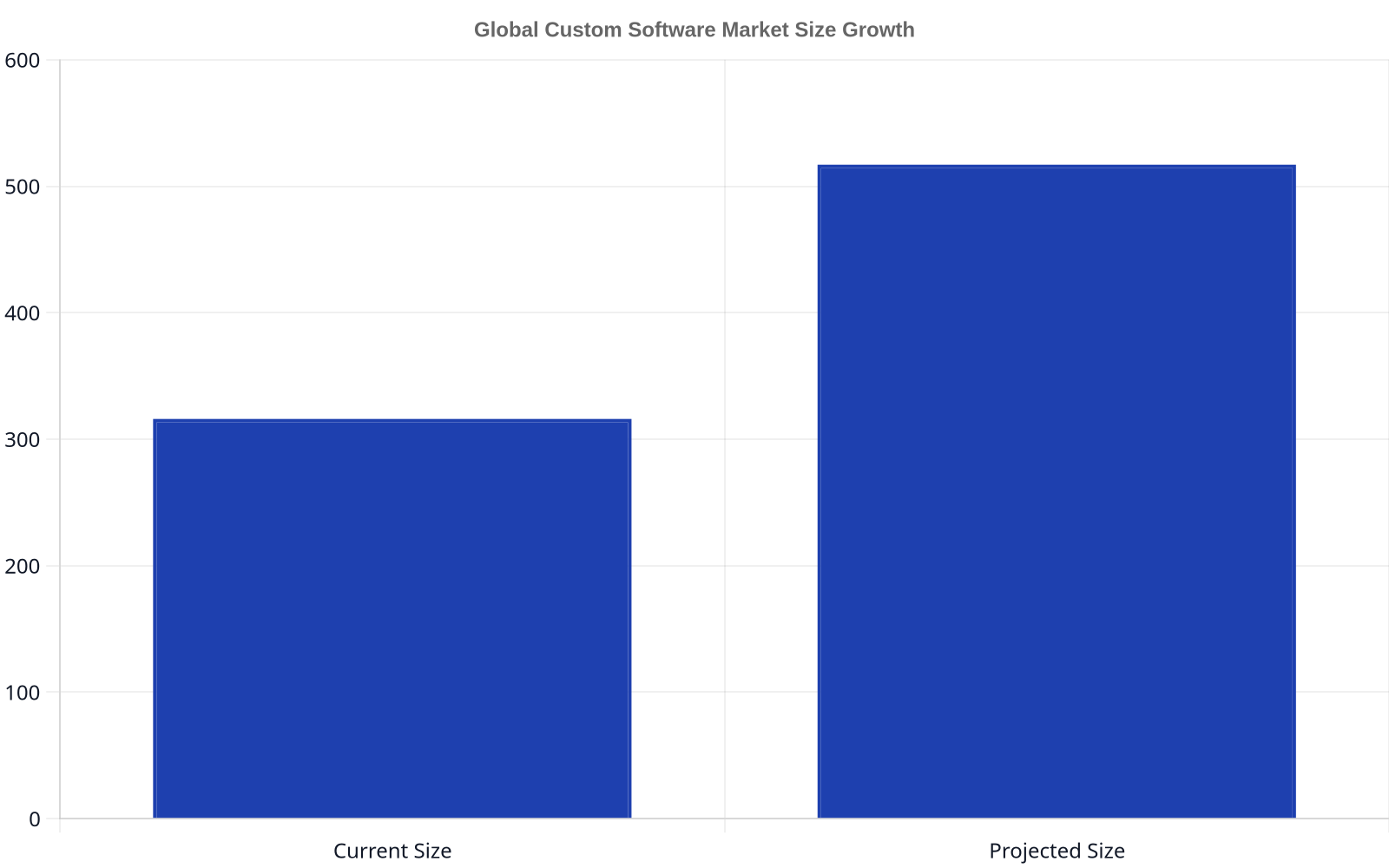
The custom software development market is not a niche segment; it’s a foundational component of the modern digital economy. Its size reflects the growing realization among businesses that generic solutions are insufficient for achieving a true competitive edge. The global market was valued at over $517 billion according to one report from Grand View Research. This enormous figure is a testament to the strategic importance enterprises place on building proprietary digital assets.
The investment continues to grow as more companies move away from rigid, off-the-shelf software and toward flexible, scalable solutions that mirror their unique operational DNA. This trend is amplified by the rise of cloud computing, AI, and big data, technologies that are best applied within a custom-built environment.

Key Considerations for Your Project
Embarking on a custom software project requires careful consideration of several key factors that will determine its success.
- Scalability: The software must be able to grow with your business. This means handling more users, more data, and more transactions without a degradation in performance. This isn’t something you can add on later; it must be designed into the core architecture from day one. Discuss your five-year growth projections with your development partner to ensure the system is future-proof.
- Security: For enterprises, a security breach can be catastrophic. Custom software must be built with a security-first mindset, incorporating best practices like encryption, access control, regular security audits, and compliance with industry standards (e.g., SOC 2, HIPAA, PCI-DSS). According to IBM, the cost of a data breach continues to rise, making upfront investment in security a critical cost-control measure.
- Integration: Your new software will not exist in a vacuum. It must communicate with your existing systems, such as your ERP, CRM, or marketing automation tools. A thorough integration plan, often reliant on a robust API strategy, is essential to avoid creating another data silo. The goal is a unified tech stack where data flows freely and securely.
- Total Cost of Ownership (TCO): The initial development cost is only part of the equation. You must also account for ongoing maintenance, hosting, licensing for any third-party components, and future enhancements. A transparent partner will provide a clear estimate of the TCO, not just the upfront build cost. While the market for AI is projected to reach $1.43 trillion by one Axis Intelligence report, integrating it without considering long-term costs can inflate TCO unexpectedly.
Don’t mistake a low initial bid for a low total cost. An inexperienced team might underbid the project, only to deliver an insecure, unscalable product that costs far more to fix and maintain than it would have to build it right the first time.
The Cost of Custom Software Development
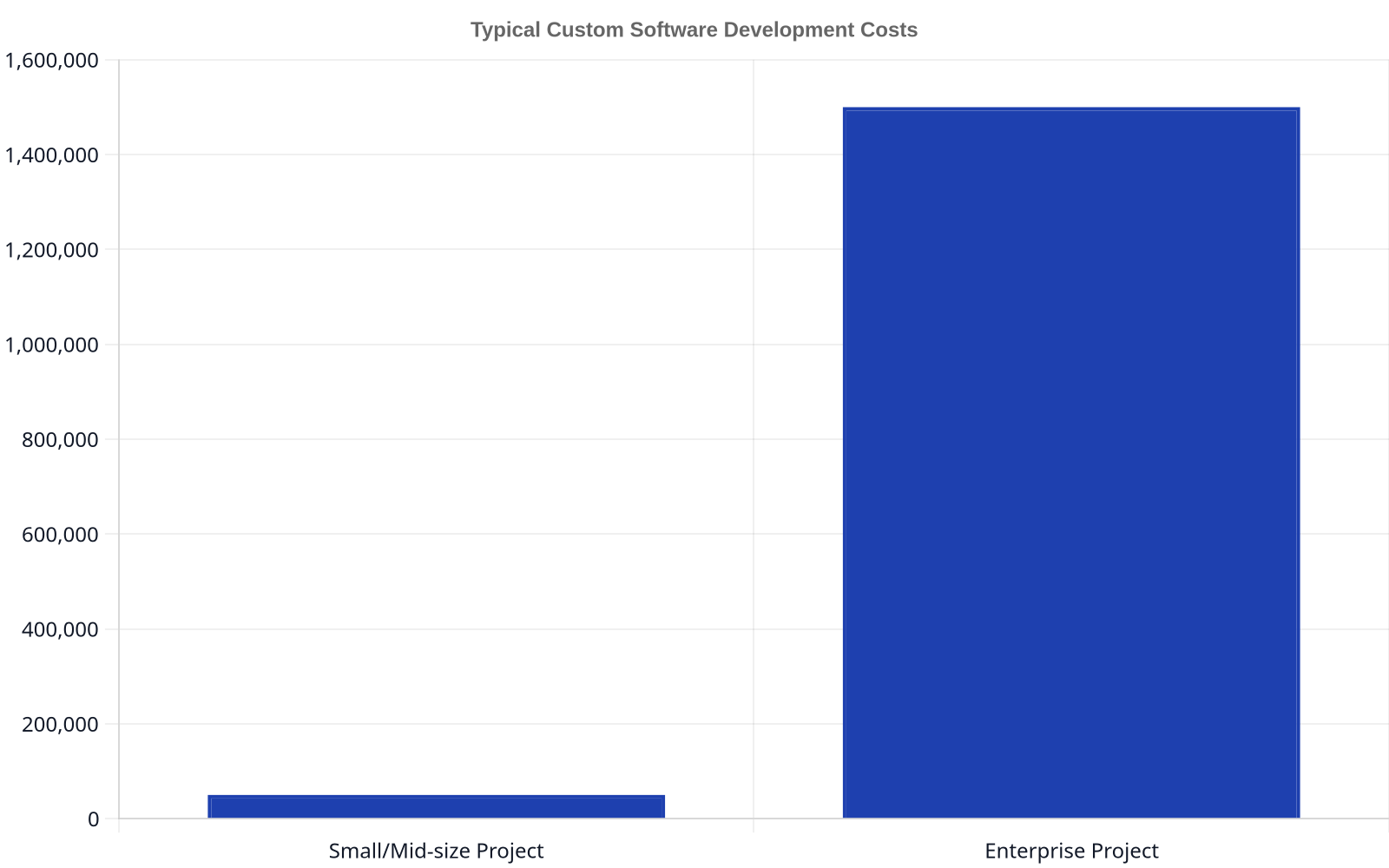
Enterprise software development costs are not standardized. The investment can range dramatically based on the project’s scope, complexity, and the team you hire. A common range cited for custom projects is between $50,000 and $500,000, a figure noted by multiple sources including Clutch.co. However, for large-scale enterprise systems with complex integrations, AI features, and stringent compliance requirements, costs can easily exceed this.
Several key factors drive the cost:
- Software Complexity: A simple internal tool with a few features will cost far less than a multi-faceted platform with dozens of user roles, complex business logic, and real-time data processing.
- Integrations: The number and complexity of integrations with third-party systems (ERPs, payment gateways, legacy databases) are a major cost driver.
- UI/UX Design: A highly polished, consumer-grade interface with complex animations and interactions will require more design and front-end development time than a simple, functional backend system.
- Team Location and Experience: An experienced, US-based team will command higher rates than an offshore junior team. While outsourcing can reduce upfront costs, it can introduce challenges with communication, quality control, and time zones that can inflate the total project cost if not managed carefully.
Further reading
FAQ
What is custom enterprise software development?
Custom enterprise software development is the design, creation, deployment, and maintenance of software applications tailored to the specific needs and processes of a large organization. Unlike off-the-shelf software, it is not a one-size-fits-all product but a proprietary solution built to address unique challenges, workflows, and growth objectives.
How long does it take to build enterprise software?
A typical custom enterprise software project can take anywhere from 4 to 12 months, or even longer. The timeline is highly dependent on the project’s complexity, the size of the development team, and the level of integration required. A simple departmental tool might be built in a few months, while a core, company-wide ERP or CRM replacement could be a multi-year initiative.
How do you ensure the security of custom software?
Security is built in at every stage of the development lifecycle. This includes conducting threat modeling during the design phase, writing secure code that follows best practices (like those from OWASP), performing regular vulnerability scanning, undergoing third-party penetration testing, and implementing strict access controls. Compliance with standards like SOC 2, HIPAA, or GDPR is also a key consideration from day one.
What are the benefits of custom software for an enterprise?
The primary benefits are efficiency, scalability, and competitive advantage. Custom software automates unique business processes, eliminating manual workarounds and improving productivity. It is built to scale with your organization, unlike off-the-shelf products that may have user or data limits. Most importantly, it can provide a proprietary tool or customer experience that your competitors cannot replicate, creating a durable market advantage.
What is the difference between custom software and customizing off-the-shelf software?
Customizing off-the-shelf software involves modifying a pre-built product (like Salesforce or SAP) to better fit your needs. This is often limited by the product’s architecture and can lead to high consultant fees and issues with future updates. Building custom software means creating a new application from the ground up, providing complete control over features, user experience, and the underlying technology stack for ultimate flexibility.
Building a unique digital platform is a significant undertaking, but it is one of the most powerful investments an enterprise can make in its own future. If your organization is ready to move beyond the limitations of generic software, let’s discuss what a tailored solution could look like for you and book a call with our team to start the conversation.