
Introduction: Launching Your Startup’s E-commerce Success
In 2026, the digital marketplace is more vibrant and crowded than ever. For a startup, launching an online store is both an incredible opportunity and a formidable challenge. The dream isn’t just to exist online; it’s to build a thriving brand that captures attention, earns trust, and drives sales. This guide is your blueprint for turning that vision into reality, detailing the strategic steps for successful ecommerce website development for startups. We’ll move beyond the basics to explore how a well-architected digital presence becomes your most powerful asset for sustainable growth.
The Startup Advantage in E-commerce
While it may seem like the e-commerce world is dominated by giants, startups possess unique advantages. Your agility allows you to pivot quickly, test new ideas without corporate red tape, and respond directly to customer feedback in real-time. Unlike established behemoths, you have the opportunity to build a brand story from the ground up, creating an authentic connection with a niche audience that values your mission. Startups aren’t just selling products; they are building communities. This ability to be nimble, personal, and purpose-driven is your secret weapon.
Why a Strong E-commerce Foundation is Crucial
In this competitive landscape, a “good enough” website is a recipe for failure. Your e-commerce site is not merely a digital catalog; it is the central pillar of your business. It’s your 24/7 salesperson, your primary marketing channel, and the very core of your customer experience. A strong foundation—built with clean code, a fast and intuitive user interface, and integrated SEO from day one—is non-negotiable. This groundwork ensures your site can handle a sudden surge in traffic, provides a seamless checkout experience that reduces cart abandonment, and gets discovered by customers on search engines. A strategic approach to ecommerce website development for startups isn’t an expense; it’s the most critical investment you’ll make in your brand’s future, enabling efficient scaling and lasting customer loyalty from your first sale. Agencies like Dynareach specialize in crafting these robust foundations, ensuring startups have the technical excellence needed to compete and win.
Step 1: Defining Your E-commerce Vision and Strategy
Before a single design element is chosen or a line of code is written, the success of your online store is determined by your strategy. This foundational step is the most critical part of the entire process of ecommerce website development for startups. A well-defined vision acts as a North Star for every decision that follows, from feature prioritization to marketing efforts. For a complete overview, explore our Ecommerce Website Development Strategy: 2026 Guide. Without this clarity, even the most technically proficient website will struggle to find its footing.
Identifying Your Niche and Target Audience
The first question to answer is: Who are you serving, and why should they choose you? Your Unique Selling Proposition (USP) is the core of your brand—it’s the specific value you offer that no one else can. Are you the fastest, the most sustainable, the most luxurious, or the most affordable? Define it clearly.
Next, build detailed customer personas. Go beyond basic demographics. Dive into your ideal customers’ psychographics: their values, goals, pain points, and online habits. Understanding whether they prioritize customer reviews, detailed specifications, or a lightning-fast checkout will directly influence your website’s design and functionality. At Dynareach, we emphasize this discovery phase to ensure the final product resonates deeply with your target audience.

Business Model and Revenue Streams
Your business model dictates the fundamental structure of your e-commerce platform. Common models include Business-to-Consumer (B2C), Business-to-Business (B2B), and Direct-to-Consumer (D2C). Each requires a different approach to site architecture, pricing, and user experience. For instance, a B2B site may need features for bulk ordering and custom quotes, whereas a D2C brand focuses on storytelling and community building. Consider your pricing strategy—will you process one-time payments, offer subscriptions, or use a combination?
Competitive Analysis and Market Positioning
You aren’t launching your store in a vacuum. A thorough competitive analysis is essential to understand the landscape, identify market gaps, and learn from others’ successes and failures. Analyze your top competitors’ websites: What is their messaging? What features do they offer? Where does their user experience fall short? This is your opportunity to find a weakness to exploit or a niche to own. This strategic analysis helps a partner like Dynareach build a solution that doesn’t just compete but sets a new standard in your market segment.
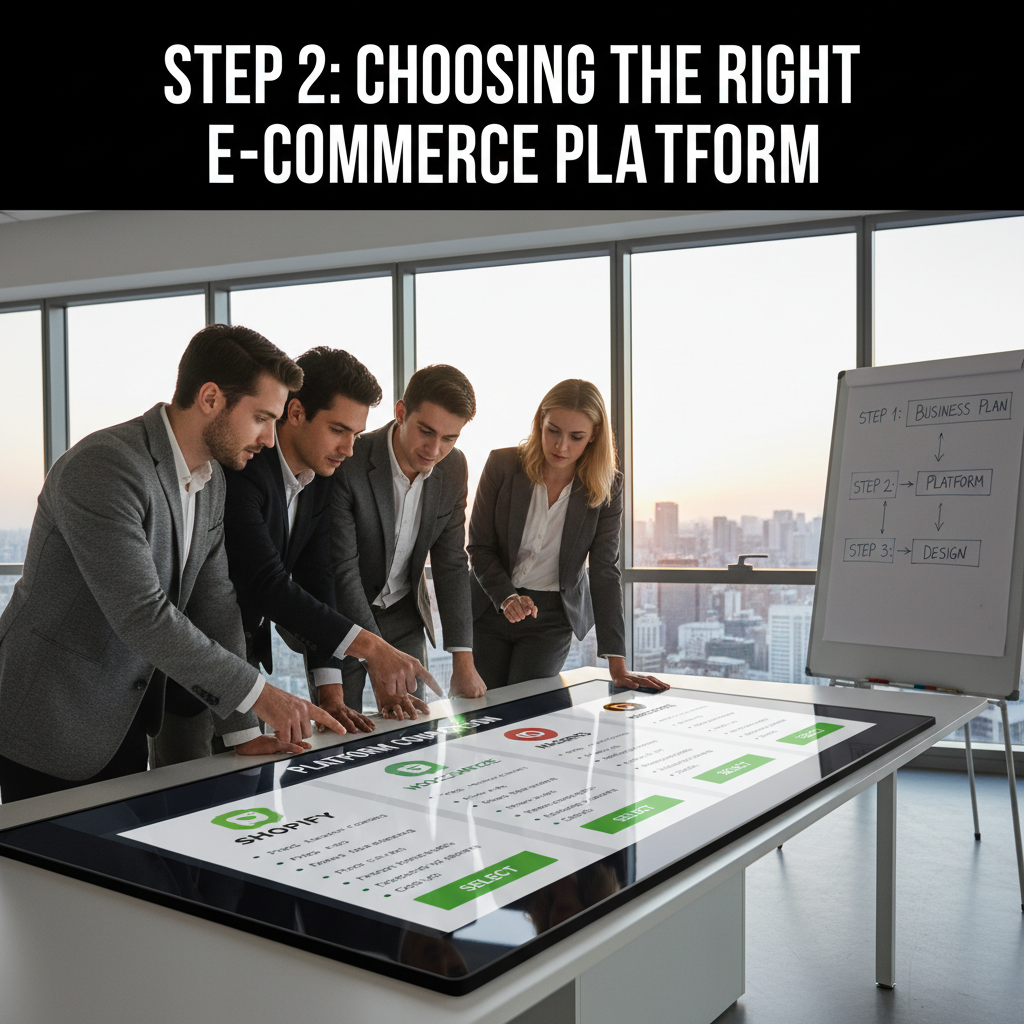
Step 2: Choosing the Right E-commerce Platform
Your e-commerce platform is the foundation of your online store. This technical decision will influence your day-to-day operations, marketing capabilities, and ability to grow, so it’s crucial to get it right from the start. Your choice sets the stage for the entire process of ecommerce website development for startups.
Self-Hosted vs. Hosted Platforms
The first major choice is between a hosted or self-hosted solution.
- Hosted Platforms (SaaS): Services like Shopify and BigCommerce are popular because they handle the technical heavy lifting. For a monthly fee, you get a secure, ready-to-use store. They are user-friendly and great for getting to market quickly, but you trade some control and customization for convenience.
- Self-Hosted Platforms (Open-Source): Solutions like WooCommerce (a WordPress plugin) give you complete control. You own your data and can customize everything. However, this freedom comes with responsibility—you manage your own hosting, security, and maintenance, which requires more technical know-how.

Key Features to Consider
Beyond the hosting model, evaluate platforms on core features. Consider the total cost, not just the monthly subscription. How intuitive is the dashboard for adding products and processing orders? A platform must also support essential integrations with payment gateways, shipping carriers, and marketing automation tools. Most importantly, your platform should allow for design flexibility to create a unique brand experience that stands out.
Scalability and Future Growth
Many startups outgrow the rigid templates and transaction fees of starter platforms. The ideal choice is one that supports your business not just on day one, but on day 1,000. While off-the-shelf solutions serve a purpose, they often create growth ceilings that can hinder your expansion.
For startups with a unique vision and ambitious growth targets, a custom-built solution is the superior path. At Dynareach, we specialize in creating bespoke e-commerce platforms that are built to scale from the ground up. A custom build eliminates creative limitations and ensures your technology infrastructure can evolve with your business needs. By planning for Website Scalability for Growing Businesses in 2026, you invest in a future-proof asset, not a temporary fix that will need a costly overhaul later.
Step 3: Designing a User-Centric and Brand-Consistent Website
Once you have your foundational technology in place, the next critical phase in ecommerce website development for startups is design. This isn’t just about making your site look good; it’s about creating a seamless, intuitive, and trustworthy environment where customers feel confident making a purchase. An effective design merges user-centric functionality with a strong brand identity to turn casual visitors into loyal customers.
User Experience (UX) and User Interface (UI) Best Practices
User Experience (UX) defines the overall feeling a customer has while navigating your site, while the User Interface (UI) is the specific set of visual elements they interact with—buttons, menus, and forms. For an ecommerce site, excellence in both is non-negotiable. Your goal is to create a frictionless path to purchase. This includes:
- Intuitive Navigation: A clear menu structure that helps users find products in just a few clicks.
- Compelling Product Pages: High-resolution images, detailed descriptions, and visible customer reviews that build confidence.
- Streamlined Checkout: A simple, multi-step process with guest checkout options and clear pricing to minimize cart abandonment.
A positive UX/UI doesn’t happen by accident; it’s the result of strategic design focused entirely on your customer’s needs and behaviors.
Branding and Visual Identity Integration
Your website is often the first and most significant interaction a customer has with your brand, so it must instantly communicate who you are. This involves consistently integrating your visual identity across every page. Your logo should be prominently placed, and your brand’s color palette and typography must be used to create a cohesive look and feel that builds recognition and fosters trust. A well-defined brand style guide is essential for this step, ensuring every design choice reinforces your identity. An expert team like Dynareach can help you translate your Brand Style Guide Creation Process: A 2026 Guide into a fully functional and visually stunning website that resonates with your target audience.
Mobile-First Design and Responsiveness
In 2026, the majority of online shopping happens on mobile devices. That’s why a “mobile-first” approach is critical. This strategy involves designing the mobile version of your site first and then scaling the experience up for tablets and desktops. This ensures the site is optimized for the smallest screens, where navigation and readability are most challenging. A fully responsive design guarantees your website looks and functions perfectly on any device, providing a seamless experience whether a customer is shopping from their couch on a tablet or on their phone during a commute. This is a core component of modern ecommerce website development for startups and a key factor in SEO rankings.
Step 4: Essential E-commerce Functionality and Integrations
Beyond a beautiful design, your online store’s success hinges on the backend machinery that powers it. The right functionality and integrations create a seamless experience for your customers and an efficient workflow for your team. Neglecting this step is a common pitfall in ecommerce website development for startups, leading to abandoned carts and operational headaches.
Payment Gateway and Shipping Solutions
The checkout is where visitors become customers, and trust is paramount. Integrating reputable payment gateways like Stripe or PayPal is essential. These processors handle sensitive credit card information securely, providing peace of mind for you and your buyers. Equally important are shipping solutions. Your website should be able to calculate shipping costs in real-time, generate labels, and provide customers with tracking information. Integrating with major carriers or shipping aggregation platforms automates this entire process.
Inventory Management and Order Fulfillment
As a startup, you can’t afford to oversell products or mismanage orders. A robust inventory management system, integrated directly into your site, is your single source of truth. It automatically updates stock levels as sales occur, preventing disappointed customers. This synchronization extends to order fulfillment, creating a streamlined path from the moment an order is placed to when it arrives at the customer’s door. This foundational work sets you up for smart growth, ensuring your operations are ready for Website Scalability for Growing Businesses in 2026.
Security, Analytics, and Marketing Tools
Modern e-commerce requires a multi-layered approach to technology. Every site must have an SSL certificate to encrypt data and protect customer information. Beyond security, you need insights. Integrating analytics tools like Google Analytics allows you to track traffic, monitor conversion rates, and understand customer behavior. Furthermore, connecting your store to a CRM or email marketing platform enables you to build customer relationships and drive repeat business.
At Dynareach, we specialize in weaving these complex systems together. Our approach to ecommerce website development for startups ensures your platform is not just live, but fully operational with the best tools for security, sales, and marketing from day one. Ready to enable your business with a powerfully integrated e-commerce solution? Explore our development services today.
Step 5: Powering Your E-commerce Site with SEO and Marketing
Launching your online store is a major milestone, but it’s only the beginning. The most successful ventures integrate marketing and search engine optimization (SEO) from the very start. A crucial part of ecommerce website development for startups is building a site that is not just functional, but also highly visible. This proactive approach is how you attract customers, build your brand, and drive sustainable growth in a crowded digital marketplace.
Foundational SEO for E-commerce Startups
SEO is the engine that brings organic, high-intent traffic to your digital doorstep. Begin by performing keyword research to understand the precise terms your ideal customers use to find products like yours. Implement these keywords strategically in your product titles, category names, and logical URL structures (e.g., yourstore.com/womens-shoes/running-sneakers). Each product page needs a unique, compelling meta description that acts as a mini-advertisement on Google’s results page. Furthermore, technical SEO elements like fast page load speeds, seamless mobile responsiveness, and a secure (HTTPS) connection are non-negotiable. A comprehensive Technical SEO Audit Checklist: 2026 Ultimate Guide can ensure your new site meets these critical standards from day one.
Content Marketing and Product Storytelling
Content is how you connect with customers beyond the transaction. Instead of just listing dry specifications, use your product descriptions to tell a story. Explain how your product solves a real-world problem or enhances a specific lifestyle, weaving in emotional and benefit-driven language. Pair this compelling narrative with high-quality, professional photography and videos from multiple angles to build desire and trust.
Beyond product pages, a blog is an invaluable asset. Write articles that answer common customer questions, provide helpful guides related to your niche, or showcase your products in action. This strategy establishes your brand as an authority and creates more pathways for customers to discover you through search.
Social Media and Paid Advertising Strategies
While SEO builds long-term momentum, social media and paid ads can deliver immediate traffic and valuable engagement. Identify the social platforms where your target audience spends their time and start building a community there. Share compelling visuals, behind-the-scenes content, and customer stories to foster loyalty. Supplement your organic efforts with paid advertising, such as Google Shopping ads or targeted social media campaigns, to reach a wider audience quickly. Finally, don’t neglect email marketing. Building an email list allows you to nurture relationships directly, announce new products, and drive repeat purchases, maximizing the value of every visitor.
FAQ: Your E-commerce Website Development Questions Answered
How much does it cost to build an e-commerce website?
The cost varies significantly based on your needs. A basic site using a template builder might have low initial setup fees but will have recurring monthly costs and transaction fees. Custom development requires a larger upfront investment but provides unparalleled flexibility and scalability. The final price is determined by the complexity of the design, the number of unique features you need, and any third-party software integrations. For a detailed breakdown, see our startup website development cost guide for 2026.
What are the most important features for a new e-commerce site?
For a new online store, focus on core features that build trust and drive sales. These include high-quality product photography and videos, intuitive navigation with clear categories, a fast and simple checkout process (including a guest checkout option), and a mobile-first responsive design. You also need secure payment gateways (like Stripe or PayPal), transparent shipping information, and an easy-to-find customer service contact page. Nailing these fundamentals creates a frictionless shopping experience that encourages repeat business.
How long does it take to develop an e-commerce website?
The timeline depends entirely on the project’s scope. A simple, template-based store can be launched in a few weeks. However, a custom-built e-commerce platform typically takes anywhere from three to six months or longer. This comprehensive process includes discovery and strategy, UI/UX design, front-end and back-end development, content integration, and rigorous testing. A thorough strategy phase is key to preventing delays and ensuring the final product meets your business goals.
What is the role of SEO in e-commerce success?
Search Engine Optimization (SEO) is crucial for attracting customers. A beautiful store is ineffective if no one can find it. Good SEO involves optimizing product pages with relevant keywords, creating valuable content like blog posts, ensuring fast load times, and building a mobile-friendly site structure. A solid SEO strategy, integrated into the ecommerce website development for startups process, drives consistent organic traffic, which is one of the most cost-effective channels for long-term growth.
Why should a startup choose a custom development agency like Dynareach?
While DIY platforms offer a quick entry point, they often come with creative and technical limitations that can hinder growth. Partnering with a specialist agency like Dynareach is an investment in a long-term strategic asset. We don’t just build websites; we create scalable, secure, and user-focused e-commerce solutions tailored to your unique brand. This expert guidance helps you avoid common pitfalls and builds a strong foundation for future success.
Conclusion: Building Your E-commerce Legacy with Confidence
Embarking on the journey of ecommerce website development for startups is a foundational step toward building a lasting digital brand. It’s a path paved with critical decisions, from initial strategy to final launch, that collectively determine your trajectory in a competitive online marketplace.
Recap of Key E-commerce Development Steps
As we’ve explored, creating a successful e-commerce store is a multi-stage process. It begins with meticulous planning and market research, followed by selecting the right technology stack that aligns with your budget and scalability needs. The journey continues through user-centric design (UI/UX) that ensures a seamless customer experience, and culminates in a secure, high-performance technical build. Each step is a building block, and a weakness in one can compromise the entire structure. Getting these fundamentals right from day one prevents costly revisions and sets a strong foundation for future success.
The Path to Sustainable Online Growth
Launching your website isn’t the finish line; it’s the starting line. Sustainable growth in e-commerce is a marathon of continuous improvement, not a sprint. The digital landscape evolves constantly, with consumer behaviors shifting and search engine algorithms updating. Your mission post-launch is to listen, analyze, and adapt. This means leveraging analytics to understand user behavior, implementing SEO strategies to improve visibility, and continually optimizing your site’s performance and user experience. A successful e-commerce business is a living entity that grows and adapts to its environment.
Partnering for Long-Term E-commerce Success
Navigating this intricate process alone can be overwhelming. The complexity of effective ecommerce website development for startups demands expertise that integrates design, technology, and marketing into a single, cohesive strategy. This is where a strategic partner becomes invaluable.
At Dynareach, we don’t just build websites; we build growth engines. We specialize in creating custom e-commerce platforms, robust branding, and data-driven SEO strategies that work in harmony to scale your business. We understand the unique challenges startups face and provide the comprehensive support needed to transform a vision into a thriving online legacy.
Ready to build an e-commerce presence that drives results? Enable your startup’s full potential by partnering with Dynareach today.